Announced 13 Oct 2026 · Sources checked
What did Singapore launch on 13 October?
Senior Minister and Coordinating Minister for National Security K Shanmugam launched Singapore’s Cybersecurity Strategy 2026 on 13 October at the opening of the 11th Singapore International Cyber Week, held at the Sands Expo and Convention Centre. The Cyber Security Agency of Singapore (CSA) says it is the country’s third national cyber strategy, after the 2016 strategy and the 2021 update, and it will be implemented over five years. Prime Minister Lawrence Wong wrote the foreword to the 68-page strategy document.
The strategy has four pillars and two enablers. The pillars are defending critical infrastructure, securing the wider cyberspace, strengthening capabilities for AI and quantum, and building resilience through global partnerships. The enablers are a world-class cybersecurity ecosystem and a better-skilled cyber workforce.
AI is central to the plan. CSA describes AI as a threat, a tool and a target: attackers use it to find weaknesses and scale up attacks, defenders can use it to work faster, and AI systems themselves need protecting. In his opening speech, Shanmugam said agentic AI is advancing faster than safeguards can keep up, pointing to an incident disclosed in Australia last month in which an AI agent gained unauthorised access to non-public data on a government portal. “AI-enabled cyber threats are really not a matter of ‘if’, but ‘when’,” he said.
What is AI harness engineering, and why not build models?
The most distinctive choice concerns which AI to use. The document says that rather than investing in developing frontier AI models, the government will build the capabilities needed to securely deploy, integrate and operate the best available models, which it argues “provides enduring value regardless of which foundation models emerge as market leaders”.
To do that it will invest in what it calls AI harness engineering as a strategic capability. The strategy defines AI harnesses as the software, workflows and orchestration layers that turn one or more AI models into working cyber tools, deciding how models interact with users, tools, enterprise systems and workflows, and carrying the safeguards, evaluation and governance around them. Shanmugam said the approach gives Singapore “the flexibility to choose between AI models” and to integrate the best ones with the data and workflows defenders need.
The example the document gives is GovTech’s Vanguard, which orchestrates AI agents to find software vulnerabilities, check findings independently and recommend fixes. Commercial security teams are moving the same way, putting agentic defenders around frontier models rather than training their own.
Which AI cyber tools does the government already run?
The strategy lists several AI tools already built in government. AEGIS is CSA’s AI-powered attack-surface scouting tool, which finds and maps exposed assets and vulnerabilities, including unknown or “shadow” assets. JEWEL is CSA’s AI-assisted web testing tool for expert-led testing of complex web-application flaws, such as business-logic issues that automated scanners can miss.
MAIA is GovTech’s AI-assisted penetration-testing capability, which uses AI agents to speed up vulnerability discovery in government systems. The document says MAIA also strengthens sovereign capability and reduces dependence on any single AI provider. AETHER, from the Centre for Strategic Infocomm Technologies (CSIT), automates malware-analysis work and has been released as open source. The Digital and Intelligence Service’s Cyber Defence Test and Experimentation Centre has tested AI agents for digital forensics.
The government says it will lead by example and then share the lessons with critical information infrastructure (CII) owners. Planned support includes funding through an AI for Cyber Experimentation Sandbox, sharing government-developed tools and harnesses “where appropriate”, practical guidance and possibly recommending suitable AI security tools. Other governments are trying similar things: the UK recently extended its frontier-AI cyber defence pilots.
How will the National Cybersecurity Command Centre work?
CSA published a separate release on the National Cybersecurity Command Centre (NC3), its operations hub for national cyber defence. The agency cites Operation CYBER GUARDIAN, announced in February 2026, as the lesson behind it. That operation brought together more than 100 government cyber defenders working with telecom operators against UNC3886, an advanced persistent threat group that had targeted Singapore’s telecommunications sector.
Shanmugam said NC3 will help in three ways. It will give a national picture of vulnerabilities and threats by fusing information from government, CII owners, security firms and international partners. It will detect threat actors earlier through proprietary detection systems and privileged intelligence; CSA says CSIT-developed detection is being deployed with selected CII owners. And it will coordinate national responses to major incidents through AI-enabled systems.
The strategy commits to progressively deploying AI across national cyber defence operations, including within NC3 and the Government Cyber Security Operations Centre. For critical infrastructure, it promises to speed up the adoption of AI-enabled defences, including frontier AI models and model-agnostic harnesses for vulnerability discovery.
What does the strategy require for securing AI and quantum?
The strategy treats AI as something that must itself be secured. It warns of data poisoning, adversarial attacks and risks that grow as agentic systems act more autonomously and interact with other agents. Government agencies will take a risk-based, defence-in-depth approach, with stronger controls, safety testing and guardrails for higher-risk deployments such as those involving classified data, public-facing systems or agentic capabilities.
CSA points organisations to its existing guidance: the 2024 Guidelines and Companion Guide on Securing AI Systems, an Addendum on Securing Agentic AI published in June 2026, and TR 147, a technical reference on cybersecurity practices for large language model applications, also from June 2026. Agent-specific risks such as prompt injection are why this guidance matters for anyone deploying agents. The UK’s AI Security Institute has published a similar list of technical priorities.
On quantum computing, CII owners have three deadlines. They must submit quantum-safe migration plans to CSA by 31 March 2027, factor quantum-safe considerations into procurement of new CII systems from 1 January 2028, and complete migration by 31 December 2031. Other organisations exposed to quantum risk are encouraged to finish by 2035, supported by a Quantum-Safe Handbook and a Quantum Readiness Index.
What did CSA’s survey of 1,000 cyber professionals find?
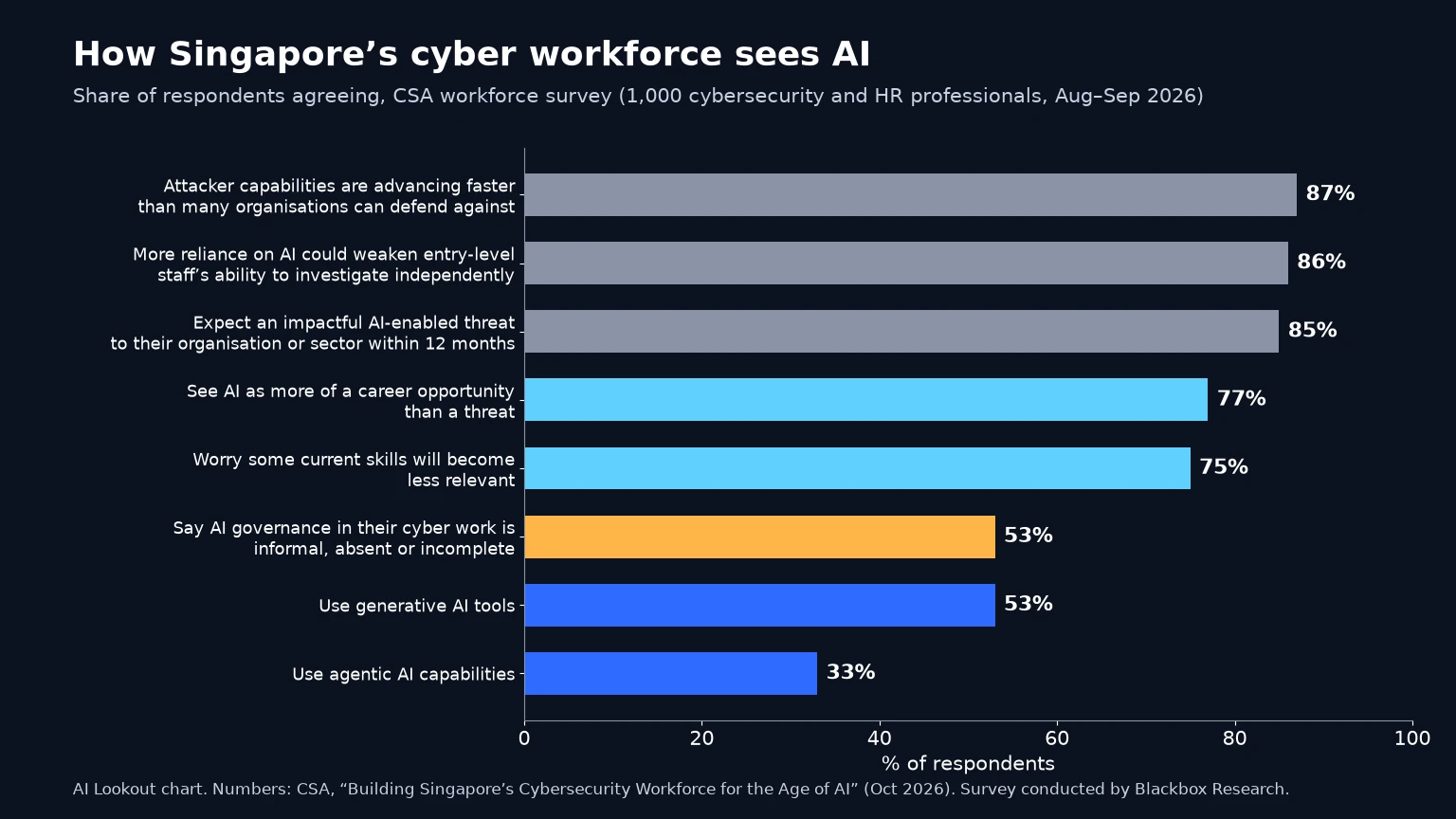
Alongside the strategy, CSA published a workforce report based on a Blackbox Research survey of 1,000 cybersecurity and HR professionals in Singapore, conducted in August and September 2026. Some 85% expect an impactful AI-enabled threat to their organisation or sector within the next 12 months, and 87% believe attacker capabilities are advancing faster than many organisations can defend against.
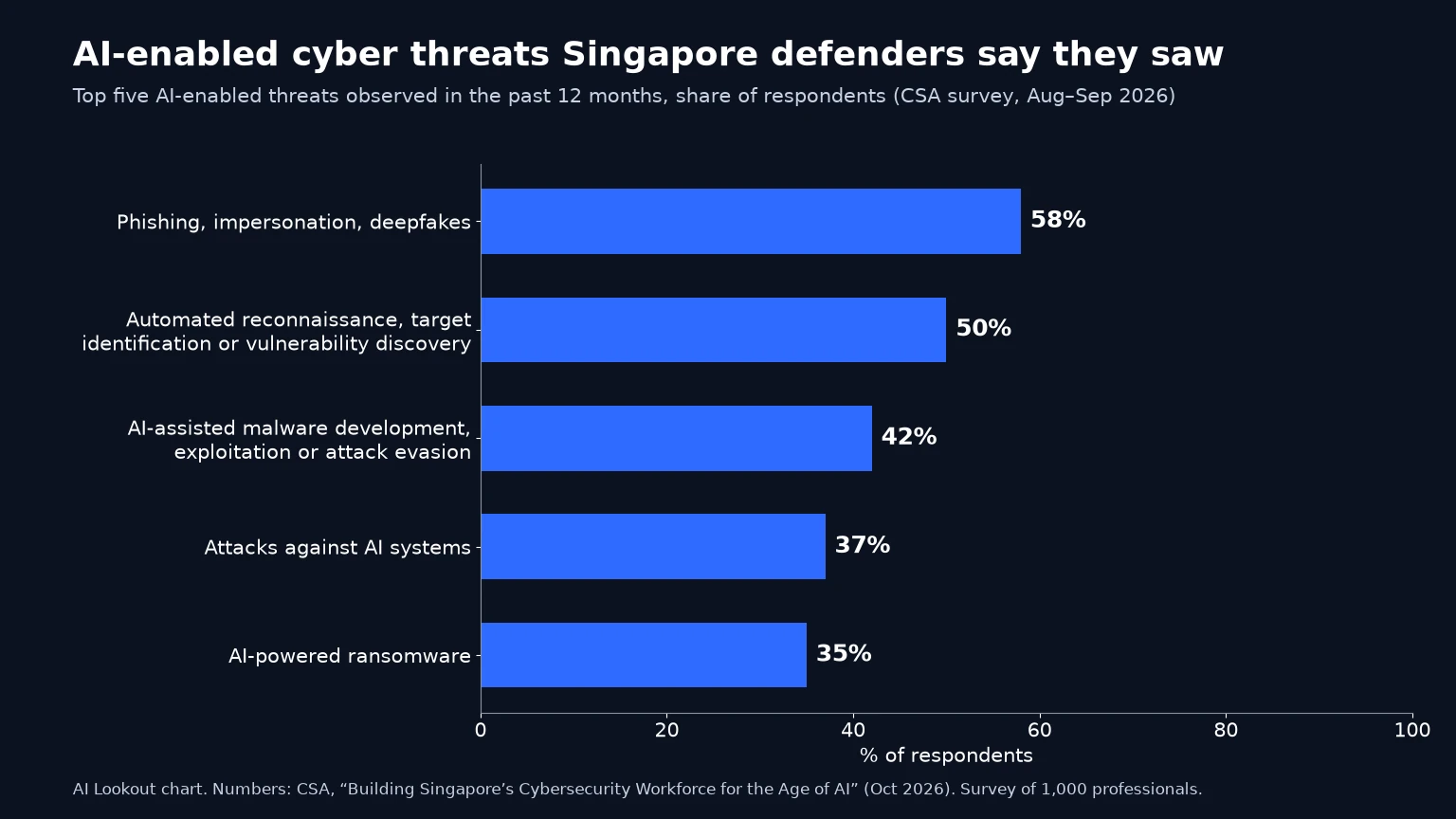
The most commonly observed AI-enabled threats in the past year were phishing, impersonation and deepfakes (58%), automated reconnaissance and vulnerability discovery (50%), and AI-assisted malware development or attack evasion (42%). Attacks against AI systems were reported by 37%.
Adoption is ahead of governance. About 53% use generative AI tools at work and 33% use agentic capabilities, yet 53% said governance of AI in their cybersecurity work was informal, absent or incomplete. Most were positive about their careers: 77% see AI as more an opportunity than a threat, although 75% worry some current skills will lose relevance.
The sharpest concern is about junior staff. 86% agreed that greater reliance on AI could weaken entry-level professionals’ ability to investigate problems or make decisions on their own, and 83% worried about fewer opportunities to build foundational experience. That matches a new field experiment with patent lawyers in which AI access helped seniors keep learning but did not help juniors. CSA’s report suggests employers may need to create supervised casework, manual validation of AI findings and structured rotations deliberately.
What else is in the five-year plan?
Beyond AI, the strategy includes a national Protective Domain Name Service that will automatically block connections to known malicious domains before they reach users, aimed at phishing, scams and malware. It also plans a Singapore Police Force Cyber Command, a National Scams List, minimum security requirements for higher-risk Internet of Things devices, higher standards for higher-risk organisations and cyber insurance pilots.
The enablers add two signature research programmes in AI and operational-technology security, efforts to attract international security firms, and a Cybersecurity Professional Accreditation Framework for practitioners.
Internationally, Shanmugam argued that competition over AI and semiconductors should not end practical cooperation on cyber threats. Minister Josephine Teo noted in her welcome address on 12 October that frontier AI companies are among this year’s senior participants.
What remains unclear?
The strategy sets direction more than detail. CSA has not published a budget for the AI measures, the size of the experimentation sandbox, or which government tools and harnesses will be shared with industry and when. Apart from the quantum deadlines, most commitments are framed as what the government “will” do over five years, without milestones.
The model-agnostic approach also brings its own work. Relying on outside models means Singapore must evaluate them carefully, protect sensitive data sent to them and keep harnesses current as models change. The document recognises this by stressing evaluation expertise and reducing dependence on any single provider. For AI companies, the plan points to a market for security-focused deployments with governments rather than sovereign model training, a trend also visible in efforts such as Anthropic’s critical-infrastructure defence programme.
Common questions
Is Singapore building its own AI model for cyber defence?
No. The strategy says the government will not invest in developing frontier AI models for this purpose. It will build AI harnesses, the software and workflows around models, so it can use and switch between the best available models.
What are the quantum-safe deadlines?
Critical information infrastructure owners must submit migration plans to CSA by 31 March 2027, consider quantum-safe requirements in procurement from 1 January 2028, and complete migration by 31 December 2031. Others are encouraged to finish by 2035.
What is the Protective Domain Name Service?
A planned national service that checks the website a device is trying to reach and blocks the connection if the domain is known to be malicious, before the user interacts with it.
What to remember
Singapore’s 2026 cyber strategy puts AI at the heart of national defence, but through model-agnostic harnesses rather than homegrown models. It adds firm quantum-safe deadlines for critical infrastructure, and CSA’s own survey shows why: defenders expect AI-enabled attacks soon while governance of their AI use lags.
Sources & further reading
- Singapore Launches Cybersecurity Strategy 2026 to Strengthen National Cyber Resilience ↗
- Singapore’s Cybersecurity Strategy 2026 (PDF) ↗
- Singapore Strengthens National Cyber Defence Through Enhanced Cybersecurity Command Centre ↗
- Opening address by SM K Shanmugam at Singapore International Cyber Week 2026 ↗
- Building Singapore’s Cybersecurity Workforce for the Age of AI ↗
- Welcome address by Minister Josephine Teo at SICW, 12 October 2026 ↗
How this story was made
Written by Kristian Kostov with AI assistance and checked against the linked sources. Company performance claims are attributed to the company. Analysis reflects AiLookout’s interpretation; we have not independently tested the products discussed. Cover photography is illustrative and does not depict the specific announcement or product.
Our editorial standards