Announced 21 Oct 2026 · Sources checked
What Reservoir filed
Independent music company Reservoir Media filed two separate copyright lawsuits on 21 October 2026 in the US District Court for the Northern District of California, one against AI music generator Suno and one against Anthropic, the maker of Claude. Music Business Worldwide reported the filings on 22 October and published both complaints.
The plaintiffs are Reservoir Media Management, its UK subsidiary and Shapiro, Bernstein & Co., which the UK entity owns. The Suno complaint (case 3:26-cv-12305) covers 1,050 compositions, and the Anthropic complaint (case 5:26-cv-12308) covers the lyrics of 853 compositions. Songs named include Joni Mitchell's "Both Sides Now" and "Big Yellow Taxi", Johnny Cash's "Ring of Fire", Madonna's "Papa Don't Preach" and Evanescence's "Bring Me to Life". Both complaints demand a jury trial.
Reservoir founder and chief executive Golnar Khosrowshahi told Music Business Worldwide that AI's "innovative technology must not be built on the exploitation of intellectual property in ways that violate the rights of creators," and that the company would "hold AI platforms legally accountable."
The case against Suno
The Suno complaint accuses the company of building "its entire business model based on copyright infringement at a scale never seen before" and sums up its alleged strategy as "infringe now, make billions by being the first mover, and try to settle on the cheap later."
Much of the factual detail comes from Suno source code that a hacker obtained and 404 Media reported on in July. Citing that reporting, Reservoir alleges Suno used proxy services from Bright Data to scrape songs and lyrics from YouTube Music, Deezer and Genius. The complaint says one YouTube Music workflow in the code saved 2,057,486 artist records and a Genius workflow logged 6,980,653 successful song-page records, and that some of the works in the case appear in the code. It also alleges the code paired cover versions with original recordings when building training examples. Suno said at the time of the hack that it mainly involved outdated code no longer in use.
On outputs, the complaint says Suno's guardrails against imitating artists are easy to get around. It gives the example of Suno refusing a prompt naming Reba McEntire but accepting a misspelled "Reba McIntyre", and a prompt for a Miles Davis-like blues track that produced two instrumentals called "Blue Note Quartet", which Reservoir calls unlicensed derivatives of Davis's music. Reservoir also uses Suno's licensing deals with Warner Music Group, BMG and Believe against it, arguing they show a working market for training licences exists.
The case against Anthropic
The Anthropic complaint is about lyrics, the text Claude can read and write. Reservoir alleges that Anthropic copied its lyrics into training data without a licence, stripped the songwriter and title credits known as copyright management information, and that Claude still produces copies and derivative versions on request.
On training data, the complaint alleges, largely on information and belief, that Reservoir's lyrics were in Common Crawl, the Books3 collection and The Pile, including The Pile's YouTube Subtitles subset. It says many lyrics reached those datasets from licensed sites such as LyricFind and Musixmatch, which are required to show credits that Reservoir says were then removed.
Reservoir accepts that Anthropic added output filters after music publishers first sued it in October 2023, but says they cover only a narrow set of prominent songs. According to the complaint, Claude Haiku 4.5 and Sonnet 5 decline to print song lyrics yet will rewrite songs "for a modern audience". It quotes Sonnet 5 itself saying the rewrites "keep landing very close to the originals: same structure, same hooks reused with light rewording." The complaint's summary line is that Anthropic's approach was to "infringe now, and hope for a two-trillion-dollar IPO later."
What Reservoir is asking for
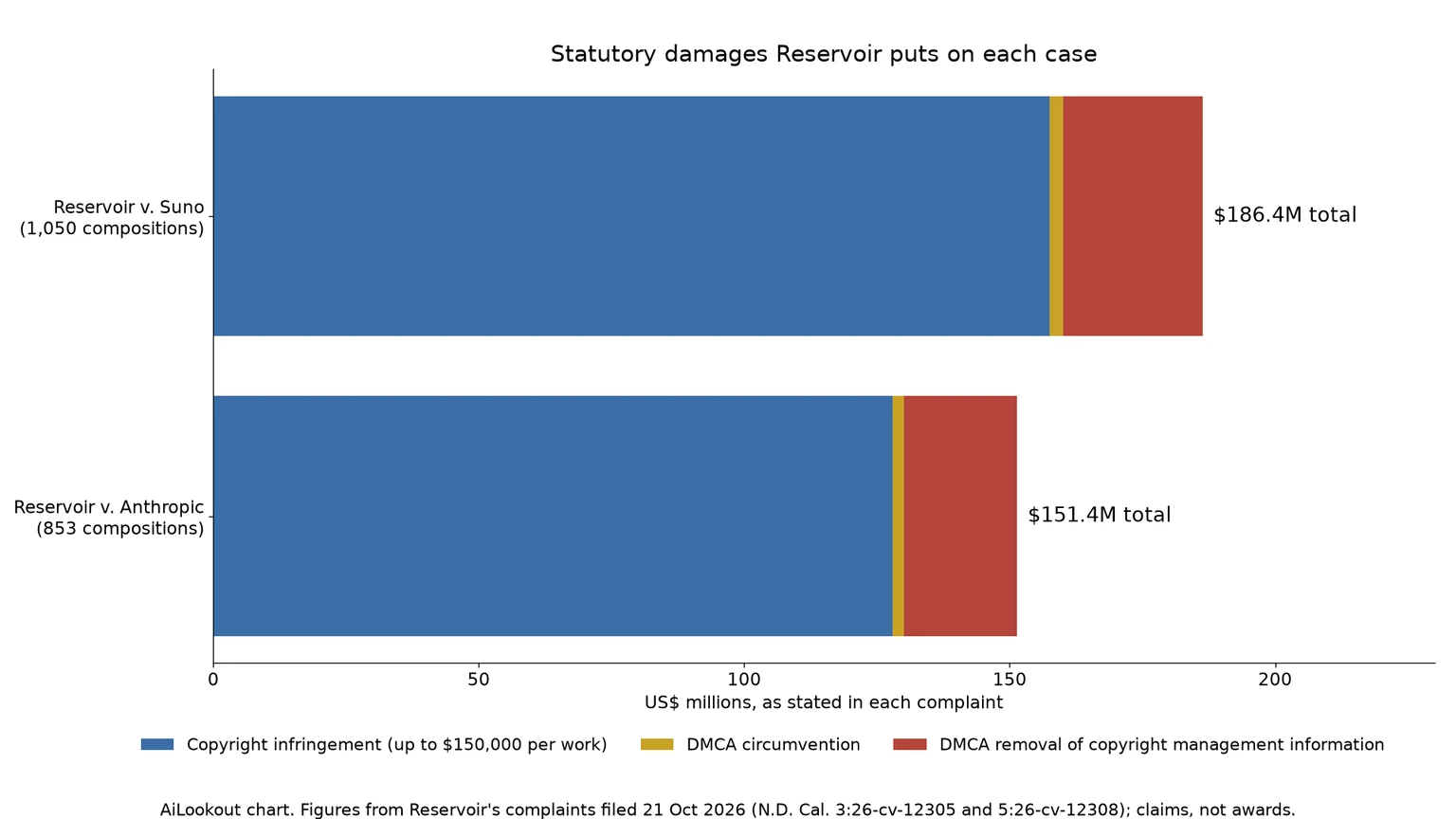
In both cases Reservoir seeks actual damages and the defendant's profits or, as an alternative, statutory damages of up to $150,000 per work for wilful infringement. Each complaint does that multiplication: $157.5 million for Suno's 1,050 works and $127.95 million for Anthropic's 853. Two further counts under the Digital Millennium Copyright Act, for circumventing access controls and removing copyright management information, add $28.875 million against Suno and $23.4575 million against Anthropic.
Added up, the pleaded figures come to about $186.4 million for Suno and about $151.4 million for Anthropic. These are ceilings a plaintiff writes into a complaint, not amounts any court has awarded. Reservoir also asks for injunctions and for unauthorised copies to be impounded or destroyed, "including copies retained in training datasets, internal repositories, model weights, and server infrastructure."
How this fits the wider fight over AI and music
Both defendants already face similar suits in the same court. Music Business Worldwide lists claims against Anthropic from Concord, Universal Music Publishing Group and ABKCO in October 2023 and January 2026, from BMG in March 2026, from Sony Music Publishing and Warner Chappell in August, and from Round Hill Music on 17 August. Suno is being sued by Universal and Sony, by Round Hill and by Regional Mexican label Gerencia 360. Reservoir's lawyers, Richard Busch of Adams and Reese with Skaggs Faucette as local counsel, also represent Round Hill and Gerencia 360.
The complaints lean on two rulings. They quote Judge William Alsup's June 2025 decision in Bartz v. Anthropic that "there is no carveout" in copyright law for AI companies; Anthropic later agreed to pay $1.5 billion to settle that authors' case. The Suno complaint also cites the GEMA collecting society's first-instance win against Suno in Munich on 31 July. Rights holders are pressing on several fronts at once, from Canadian newspapers suing Anthropic in Ontario to a US judge ordering Meta to name who approved pirated book downloads.
Streaming platforms are reacting too. Spotify says it pulled 50 million AI tracks from recommendations this year, and YouTube Music is labelling AI-generated songs, while Suno itself has shifted towards licensed deals with some labels.
What we could not verify
AI Lookout read both complaints and Music Business Worldwide's report on 22 October 2026. Everything attributed to Reservoir above is an allegation that has not been tested in court, and much of it is pleaded on information and belief. We did not see a response from Suno or Anthropic to these filings in the sources we read, and we did not test Suno or Claude ourselves.
What happens next
Suno and Anthropic will have to answer the complaints or move to dismiss them. Watch for whether the court relates the new cases to the music suits already pending in the district, whether either company settles or signs a licence with Reservoir, and whether rulings in the older Concord and Universal cases decide the training and output questions first.
Common questions
Why is Reservoir suing Suno and Anthropic?
Reservoir says both companies used its copyrighted songs without a licence to train AI models, removed credit information, and that their products still generate derivative versions of its works.
How much money is Reservoir asking for?
The complaints plead statutory damages of up to about $186.4 million against Suno and $151.4 million against Anthropic, or actual damages and profits instead. No court has awarded anything.
Have Suno and Anthropic responded?
AI Lookout did not see a response from either company in the sources it read on 22 October 2026.
Sources & further reading
- Reservoir Media Management, Inc. et al. v. Suno, Inc., Complaint, Case 3:26-cv-12305 (N.D. Cal.) ↗
- Reservoir Media Management, Inc. et al. v. Anthropic PBC, Complaint, Case 5:26-cv-12308 (N.D. Cal.) ↗
- Reservoir sues Suno and Anthropic for infringing songs by Joni Mitchell, Johnny Cash, Madonna and more ↗
How this story was made
Written by Kristian Kostov with AI assistance and checked against the linked sources. Company performance claims are attributed to the company. Analysis reflects AiLookout’s interpretation; we have not independently tested the products discussed. The cover places the companies’ own logos, taken from public-domain or openly licensed files credited in the caption, on a plain background. It is not a product photograph, a screenshot, or an endorsement.
Our editorial standards