
Announced 6 Oct 2026 · Sources checked
What did StreamNative open on 6 October?
StreamNative’s engineering blog dated 6 October 2026 announced that Orca Agent Engine is open source under Apache 2.0 in Developer Preview, alongside the CLI, TypeScript/Python/Go SDKs, and ready-made skills and cookbooks. Authors Sijie Guo, Rui Fu, Pengcheng Jiang, and Guangning E frame OAE as a declarative runtime for building, deploying, and governing AI agents in the operator’s own environment after roughly a year of closed operation.
The public repository orca-ae/orca-agent-engine carries an Apache License 2.0 LICENSE file and a README that calls the project a self-hosted implementation of the managed-agents API. GitHub’s release list we opened shows v0.5.1 published 29 September 2026; the README’s status section says the current release line is 0.5.x and that APIs may change between minor versions. The open-source announcement is the editorial event for this article; the September tags are the version line that announcement points readers toward.
For the product category Orca is answering—long-running managed agent sessions rather than single chat completions—see our coverage of Anthropic’s managed agents dynamic workflows and the broader agent sandboxing explainer.
How is the runtime split apart?
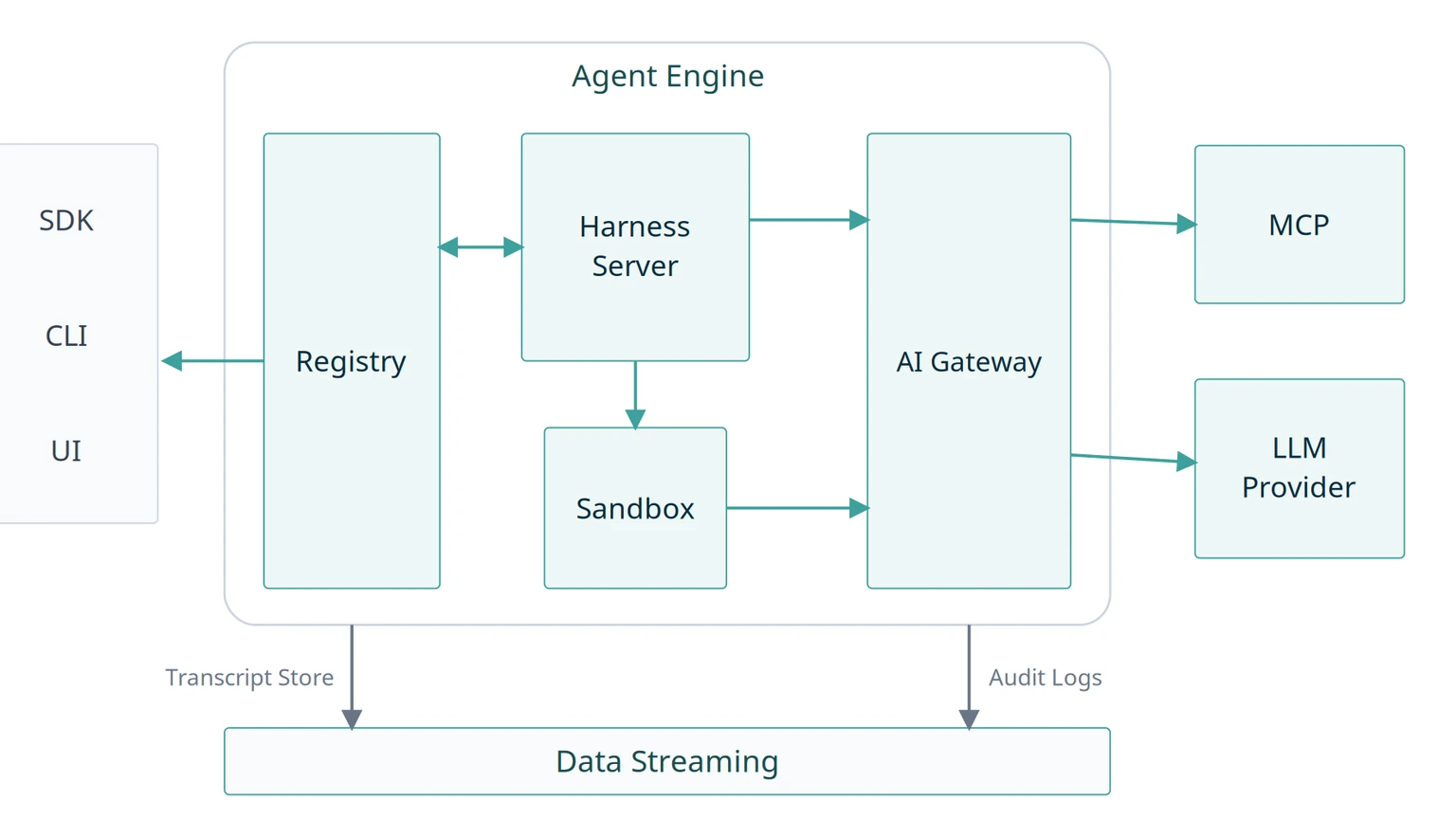
The README decomposes the system into four parts: a registry that exposes the Anthropic-compatible REST/SSE API and keeps metadata in Postgres; a harness runtime (harness-server or attached environment workers) that runs the agent loop; pluggable sandboxes for session code (local OS sandboxing, E2B, OpenSandbox, AgentENV, or in-memory for tests); and egress through the AI Gateway image ghcr.io/orca-ae/orca-ai-gateway, which injects vault credentials so secrets never enter the sandbox.
The companion “Inside Orca Agent Engine” post, also dated 6 October 2026, states the design debt Orca inherited from Anthropic’s managed-agents engineering write-up—decouple brain from hands, keep credentials out of the sandbox, treat the session as a durable log—and adds multi-harness/multi-provider support plus operator-owned infrastructure. Transcripts stream through Kafka by default, with Postgres or Pulsar options; files, memory, and skills live in S3-compatible object storage.
An official architecture diagram in docs/images/ (Apache-2.0 with the repository) shows SDK/CLI/UI clients hitting the Registry, the Harness Server coordinating a Sandbox, both reaching the AI Gateway for MCP and model calls, and transcripts/audit logs landing in a data-streaming layer. That diagram is a vendor illustration of intended topology, not a deployment we reproduced.
What does “governance outside the agent” mean in practice?
The announcement’s governance pillar is that guardrails only tighten downward: organization, workspace, agent, and session rules each return allow, ask, or deny, and the strictest answer wins. Soft budget thresholds ask before more spend; hard caps stop the session. Orca does not automatically downgrade models to save money—operators must change configuration. Provider credentials stay in a vault resolved at the gateway.
That design is the opposite of stuffing an allowlist into the system prompt and hoping the model complies. It is closer in spirit to platform sandboxes that deny syscalls the agent cannot rewrite. The difference is that Orca’s unit of work is a managed session with a replayable event log, not only a local process jail.
If you are assembling a layered defense, compare this control plane with host-level tools such as NVIDIA OpenShell and Apple-silicon-focused AWS Strands Box: complementary layers, not substitutes.
How far does Claude Managed Agents compatibility go?
Orca advertises that official Anthropic SDKs can call supported operations by changing the base URL and sending the anthropic-beta: managed-agents-2026-04-01 header. Self-hosted docs we opened say every client—ork CLI, TypeScript/Python SDKs, Anthropic-compatible SDKs, and raw HTTP—talks to the same registry API. Extension groups such as runtime.runorca.ai/v1, policy.runorca.ai/v1, and pricing.runorca.ai/v1 appear on the open engine; StreamNative Cloud adds cloud.sn.io/v1 capabilities the OSS trigger contract does not fully mirror.
The practical reading is: port clients that stay inside the documented shared operations, then read the generated conformance matrix before you assume feature parity on sessions, triggers, or replicas. The announcement is explicit that the matrix documents differences; that sentence is load-bearing.
Observability export is one-way OpenTelemetry (or Langfuse-compatible) traces; operators choose whether prompts and tool output are included. Orca does not import your evaluation datasets or scores.
How do you try it, and what should you not assume?
The README’s quick starts use Docker Compose plus Node 22.21+/24.9+ and pnpm 9. make self-hosted-up brings Postgres and RustFS, runs the registry and an environment worker, and supports pnpm e2e:self-hosted with a mock harness that needs no model key. make stack-up adds Kafka and the AI Gateway; real agent loops need provider keys in services/dev/.env. A Helm chart under charts/ deploys registry, harness-server, and gateway but expects you to supply Postgres, streaming, object storage, and sandbox backends.
Limitations to keep in the open: Developer Preview / 0.5.x instability; harness switches that require new agent resources; Linux sandbox paths that need srt and bubblewrap; Cloud-only extensions you will not get from the OSS trigger schema; and author-reported architecture claims we did not load-test. Ai Lookout did not clone the repo into a running stack for this article.
If your near-term need is a single-laptop Seatbelt jail for one coding agent, a lighter sandbox may be enough. If your need is a multi-tenant registry with session replay, budgets, and Anthropic-shaped clients against infrastructure you operate, Orca is the clearer evaluation target—preview caveats attached.
Common questions
Is Orca the same as Anthropic’s hosted Managed Agents?
No. Orca implements a large overlapping API surface so official Anthropic SDKs can point at your registry base URL for supported operations. The project’s conformance matrix documents gaps; StreamNative Cloud adds extensions the open engine does not.
Which harnesses and models does the open engine claim?
The 6 October announcement lists Claude Agent SDK, Codex, and Pi harnesses, and Anthropic, OpenAI, Google Gemini, DeepSeek, MiniMax, plus OpenAI-compatible endpoints for models. Changing harness mode currently requires creating a new agent, not an in-place switch.
What does “developer preview” mean here?
The README states APIs, configuration, and storage formats can change between minor 0.5.x releases. Docs warn operators to read compatibility and roadmap notes before planning production cutovers.
What to remember
Orca’s open-source moment is a self-hostable managed-agent runtime with governance and credentials outside the sandbox—useful to evaluate now, unstable to freeze as a 2026 production standard without the preview caveats.
Sources & further reading
How this story was made
Written by Kristian Kostov with AI assistance and checked against the linked sources. Company performance claims are attributed to the company. Analysis reflects AiLookout’s interpretation; we have not independently tested the products discussed. Cover photography is illustrative and does not depict the specific announcement or product.
Our editorial standards