Announced 20 Oct 2026 · Sources checked
What the new filings show
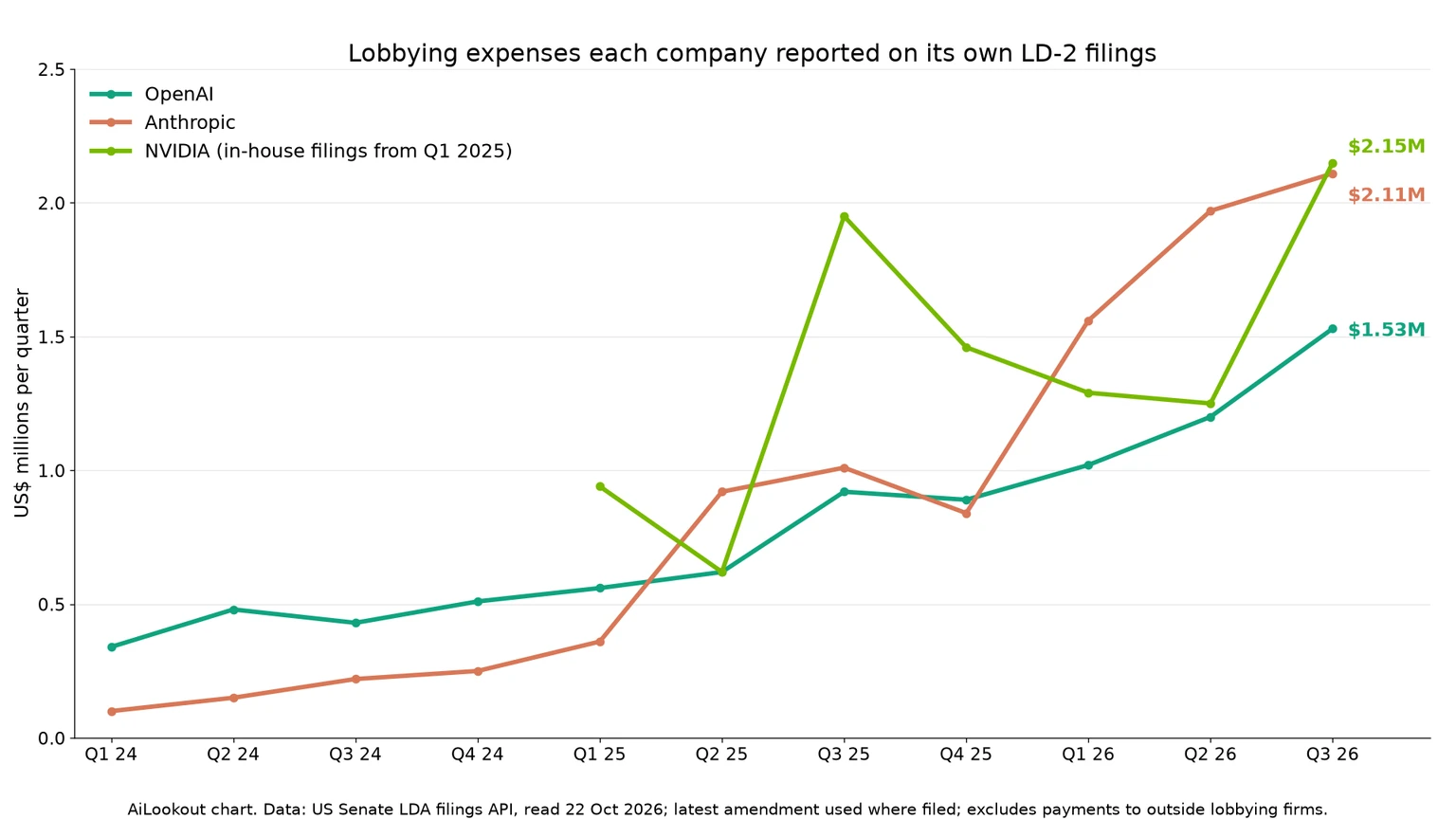
OpenAI, Anthropic and NVIDIA each reported their biggest quarter of federal lobbying so far for July to September 2026, according to disclosures filed on 20 October. The Verge reported the totals on 22 October, and AI Lookout checked each figure against the reports in the US Senate's lobbying database.
NVIDIA's LD-2 report lists $2,150,000 in in-house lobbying expenses for the quarter. Anthropic's report lists $2,110,000, and OpenAI's, filed by OpenAI OpCo, lists $1,530,000. Together that is $5.79 million, which The Verge rounded to nearly $6 million. Apple, filed separately, reported $3,090,000, which The Verge says is the first time it has gone above $3 million in a quarter.
An LD-2 is the quarterly report US companies file under the Lobbying Disclosure Act. The in-house figure covers the company's own staff and costs. Money paid to outside lobbying firms appears in those firms' separate reports, so it comes on top of these totals.
How fast the spending has grown
Each figure beats the company's previous high. OpenAI's best quarter before this was $1.2 million in the second quarter of 2026, and Anthropic's was $1.97 million in the same quarter. NVIDIA's earlier high was $1.95 million for the third quarter of 2025, according to an amended report.
The longer trend is steeper. OpenAI reported $340,000 for the first three months of 2024 and did not pass half a million dollars in a quarter until the end of that year. Anthropic reported about $100,000 for the first quarter of 2024, so its latest quarter is about 21 times higher. The Verge notes that Anthropic's biggest quarter last year was just over $1 million.
What OpenAI lobbied on
OpenAI's report lists contacts with the House and Senate, the Commerce and State departments, the Small Business Administration and the White House. The issues it names include a discussion draft of the AI Research, Innovation, and Accountability Act from senators John Thune and Amy Klobuchar, the Secure Frontier AI Act, cybersecurity evaluations of frontier models and antitrust protections for companies that share information about AI security threats.
The Verge links some of that work to fallout from what it calls "the Hugging Face attack", though the filings themselves list only topics, not the reasons behind them. OpenAI also lobbied on copyright, according to The Verge's reading of the report.
What Anthropic and NVIDIA lobbied on
Anthropic gave the most detailed list of the three. Its report names more than a dozen bills, including the AWARE Act, the AI OVERWATCH Act on chip export controls, the Chip Security Act, the Kids Online Safety Act, the GUARD Act, the FRONTIER Act, the AI AGENT Act, the Secure A.I. Development Act and the fiscal 2027 defense bill. It also lists the Ratepayer Protection Act, which aims to make data center developers carry their own energy costs, and two executive orders, 14409 and 14434. The Verge identifies the latter as President Trump's order renaming AI "Super Intelligence", the change behind the State Department cable we reported on this week.
The filing lands a few days after Anthropic gave lawmakers draft legislation limiting when Washington could halt a model, and while it prepares for a stock market listing. Its draft IPO filing showed $16.3 billion in revenue, which puts $2.1 million a quarter in perspective.
NVIDIA's report covers Congress and several agencies and White House offices. Its issues include the Chip Security Act, the AI OVERWATCH Act, the Remote Access Security Act, the fiscal 2027 defense bill, export controls, energy, quantum computing, competition policy, 6G networks and what The Verge calls "responsible AI design." Chip export rules affect NVIDIA's sales to China more directly than any other issue on the list.
The outside firms on top
The in-house totals understate what the companies spend. Separate third-quarter reports from outside firms show OpenAI paying Akin Gump $110,000, Miller Strategies $150,000 and DLA Piper $50,000. Anthropic paid at least eight firms, the largest being Ballard Partners at $380,000 and Continental Strategy at $150,000. NVIDIA's outside firms include BGR Government Affairs at $120,000, Brownstein Hyatt Farber Schreck at $110,000, Tiber Creek Group at $110,000 and The Nickles Group at $100,000.
Adding those firms would raise Anthropic's quarter to roughly $3 million, NVIDIA's to about $2.6 million and OpenAI's to about $1.8 million, by AI Lookout's count of the reports we found. Outside firms report income in rounded bands, so these totals are approximate.
How this compares with Big Tech
The amounts are still small next to the largest tech companies. In-house reports for the same quarter show Meta at $5.88 million, Amazon at $4.49 million, Google at $3.23 million and Microsoft at $2.44 million. The Verge notes that Microsoft has spent at least $2 million a quarter since 2021, so NVIDIA, Anthropic and OpenAI are now spending at roughly Microsoft's level, a few years after starting from almost nothing.
The timing is notable. The quarter included a White House lunch in late September where tech chiefs signed what The Verge calls a "morally binding" AI safety accord, and it came shortly before the president named an AI adviser and task force. Washington's push to rename AI has also reached international bodies such as the IMF. With the US midterm elections weeks away, The Verge expects lobbying by AI companies to keep growing whichever party wins Congress.
What the numbers do not tell you
Lobbying reports show how much a company spent and which topics and agencies it covered, but not what it asked for or whether it supported or opposed a bill. They also leave out campaign donations, spending by industry groups and super PACs, and money spent on state lawmakers. AI Lookout did not ask the companies about their filings for this article, and the reports can still be amended.
What to watch next
Fourth-quarter reports are due by 20 January 2027 and will cover the midterm elections and the first months of the new AI task force. Watch whether OpenAI and Anthropic keep raising their in-house budgets, whether Google DeepMind or xAI start appearing as separate big spenders, and whether bills on the lists, such as the Chip Security Act and the Kids Online Safety Act, move in Congress after the election.
Common questions
How much did OpenAI spend on lobbying in Q3 2026?
OpenAI OpCo reported $1,530,000 in in-house lobbying expenses for July to September 2026, up from $1.2 million the quarter before, plus fees paid to outside firms.
Which AI company spent the most on lobbying?
Of the three, NVIDIA reported the most at $2.15 million in-house, just ahead of Anthropic at $2.11 million. Counting outside firms, Anthropic's total is higher at roughly $3 million.
Where do these lobbying numbers come from?
From quarterly LD-2 reports filed under the US Lobbying Disclosure Act, which are public in the Senate's lobbying database.
Sources & further reading
How this story was made
Written by Kristian Kostov with AI assistance and checked against the linked sources. Company performance claims are attributed to the company. Analysis reflects AiLookout’s interpretation; we have not independently tested the products discussed. The cover places the companies’ own logos, taken from public-domain or openly licensed files credited in the caption, on a plain background. It is not a product photograph, a screenshot, or an endorsement.
Our editorial standards