Announced 13 Oct 2026 · Sources checked
What did NVIDIA announce on 13 October?
NVIDIA’s GeForce News post DLSS 5 Comes To Hogwarts Legacy & RTX Spark, Powered By 2X Faster Model, published 13 October 2026, bundles five updates around DLSS 5, the generative rendering feature NVIDIA launched in September. The headline is a new version of the 3D-Guided Neural Rendering model that NVIDIA says runs about twice as fast as the September release.
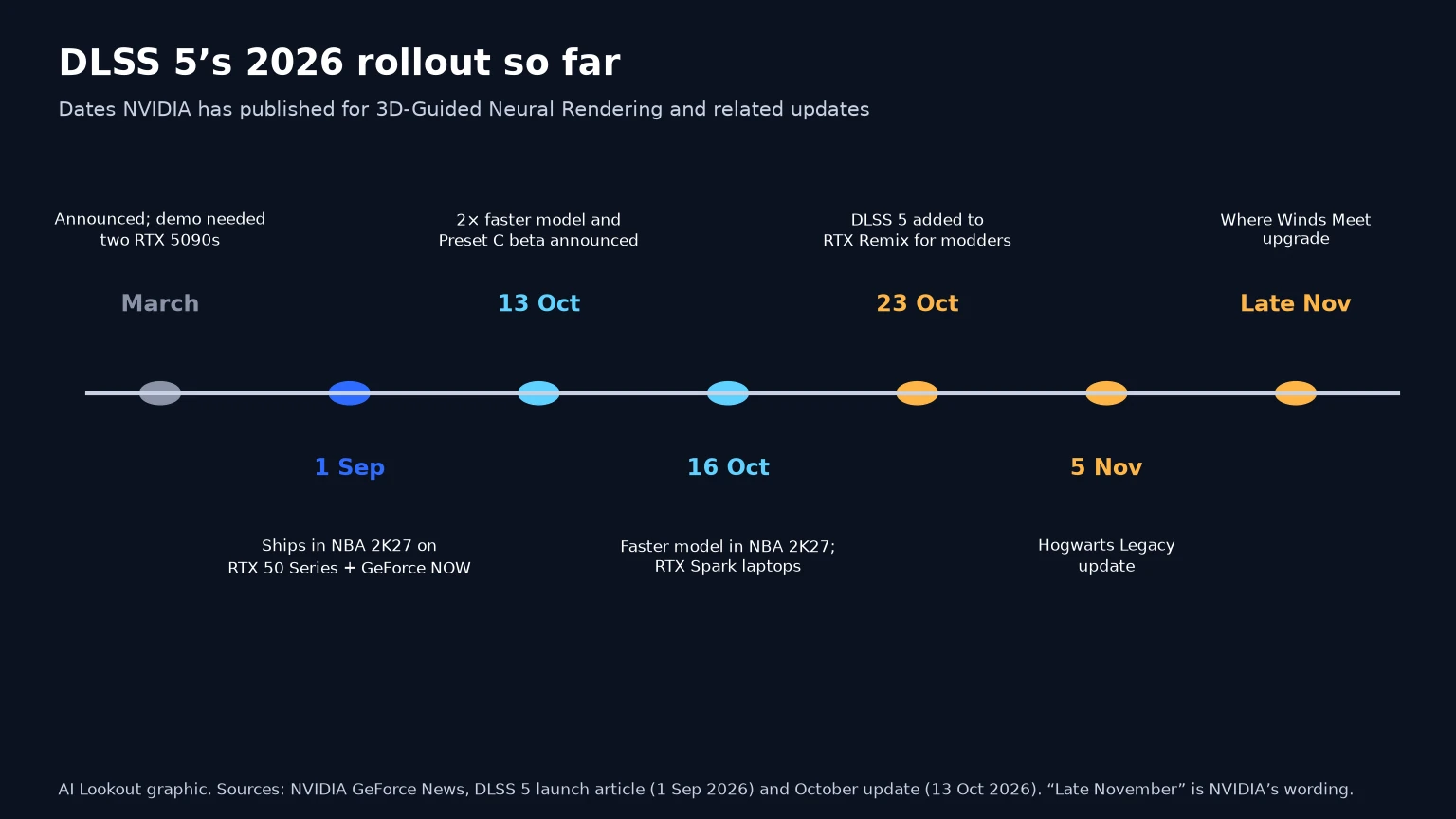
Around that model update sit four rollout items: DLSS 5 for NVIDIA RTX Spark laptops on 16 October, DLSS 5 in Hogwarts Legacy on 5 November, DLSS 5 in Where Winds Meet in late November, and DLSS 5 inside the RTX Remix modding platform on 23 October. NVIDIA also released a beta of a faster Frame Generation Performance Mode through the NVIDIA app the same day.
Taken together, it is NVIDIA’s first big expansion of DLSS 5 beyond its single launch title, NBA 2K27, and its first published claim about shrinking the model rather than only optimising the pipeline around it.
What is DLSS 5’s 3D-Guided Neural Rendering?
NVIDIA’s September launch article describes DLSS 5 as a change in what DLSS does. Earlier DLSS features reconstruct data the game already produced: Super Resolution upscales, Frame Generation inserts frames, Ray Reconstruction cleans ray-traced lighting. NVIDIA says that today’s DLSS 4.5 suite can draw 23 of every 24 pixels on screen. DLSS 5 adds detail that real-time budgets usually strip out, such as light scattering through skin, light passing through hair and foliage, and deeper contact shadows.
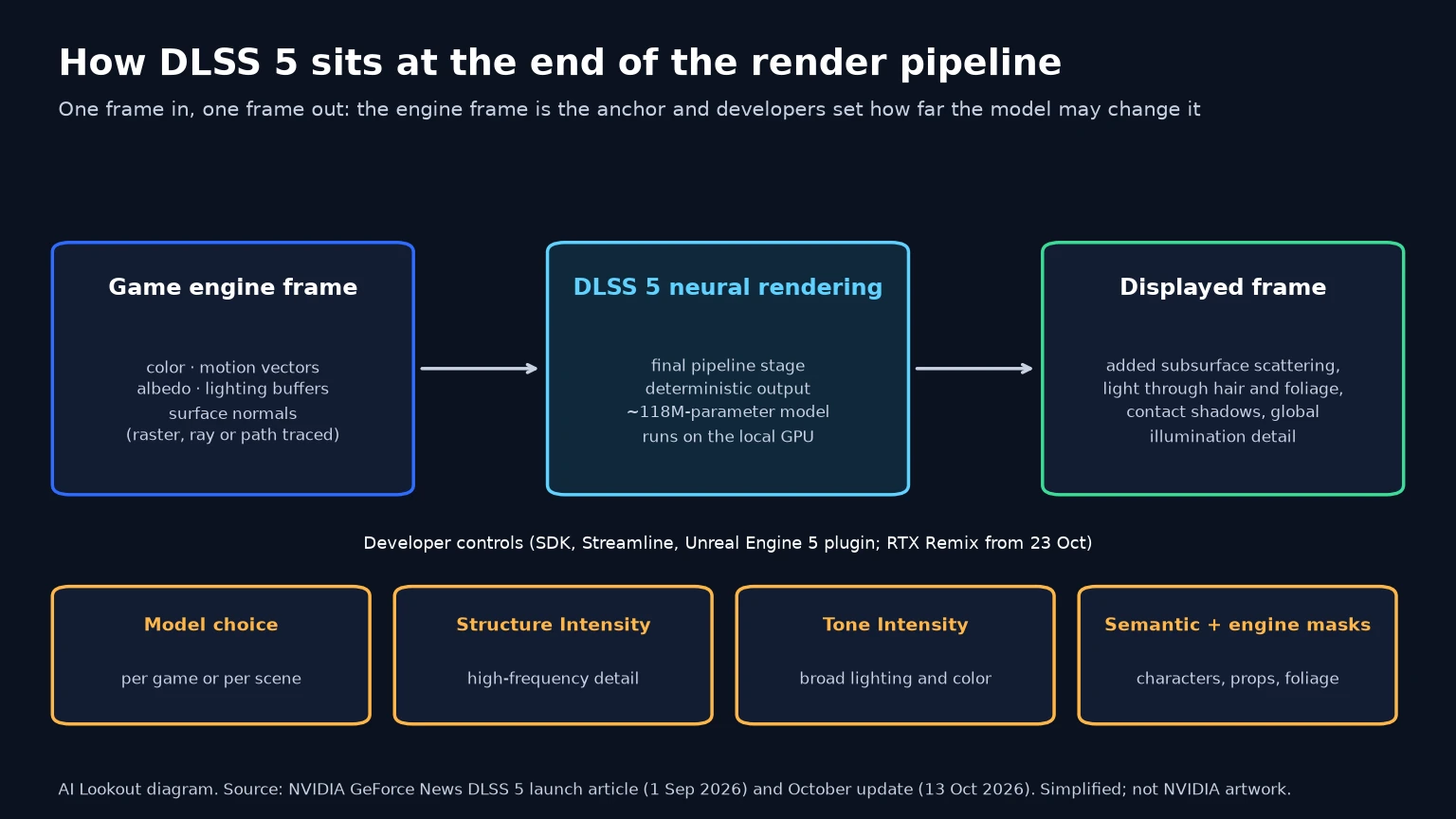
The company stresses that this is not text-to-image generation. The model takes the engine’s finished frame, including color and motion vectors and, according to NVIDIA, training on engine data such as surface albedo, lighting and surface normals, and treats it as an "unyielding foundation." It runs as the last stage of the graphics pipeline, one frame in and one frame out, and NVIDIA says its output is deterministic for identical input frames and temporally stable because it uses the engine’s motion vectors.
Developers get controls through the DLSS 5 SDK: a choice of models with different weights per game or per scene, a Structure Intensity setting for high-frequency detail, a Tone Intensity setting for broad lighting and color, semantic masking that can treat characters and environments differently, and engine-level masks for props such as glassware or foliage. For players it is an on or off toggle.
What changed in the October model?
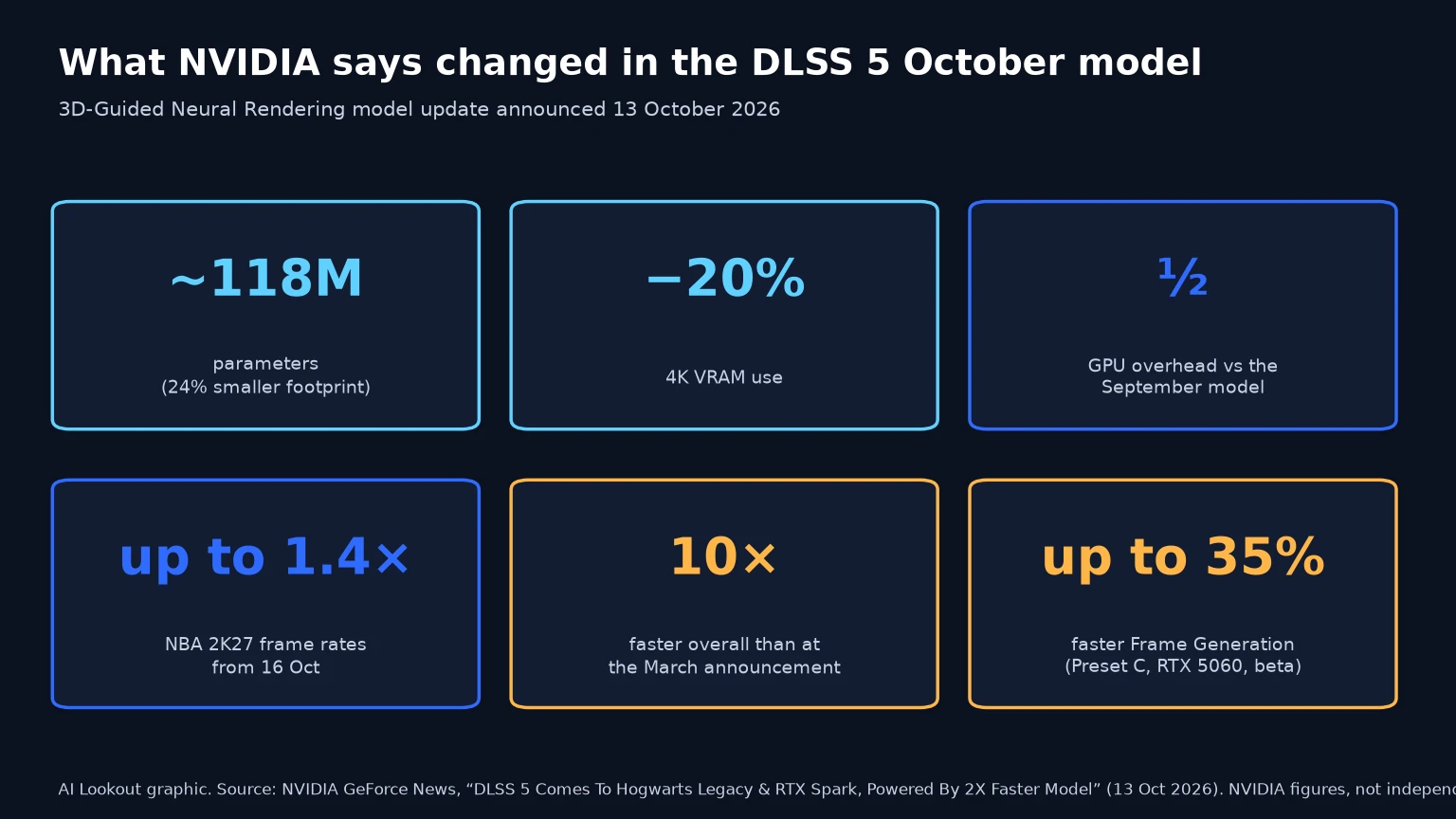
According to the 13 October post, a mix of pipeline optimisations and model refinements makes the 3D-Guided Neural Rendering model about 2x faster this week. NVIDIA says the October version shrinks the footprint by 24% to roughly 118 million parameters and cuts VRAM use at 4K by 20%, giving half the GPU overhead of the September version "while maintaining comparable visual fidelity."
NVIDIA puts the cumulative gain at 10x since DLSS 5 was announced in March. That fits its September account, which said the feature had gone from needing two GeForce RTX 5090s to running on a single card, a 5x gain, and promised further model updates in the autumn.
In NBA 2K27, the only DLSS 5 game so far, NVIDIA says the new model lifts frame rates by up to 1.4x when it arrives on 16 October for GeForce RTX 50 Series GPUs, RTX Spark laptops and GeForce NOW. It will also ship by default in future DLSS 5 games. For context, NVIDIA’s compact on-device approach mirrors a broader push to make neural workloads fit consumer GPUs, from Google’s ML Drift GPU inference engine to laptop-class AI PCs.
Which games and devices get it, and when?
The RTX Spark laptops getting DLSS 5 on 16 October are the Windows machines Microsoft and NVIDIA introduced earlier this month, covered in our report on RTX Spark Windows PCs and hybrid intelligence. Until now DLSS 5 was limited to GeForce RTX 50 Series desktop and laptop GPUs and to GeForce NOW Ultimate streaming.
Hogwarts Legacy gets DLSS 5 in an update on 5 November for RTX 50 Series, GeForce NOW and RTX Spark, alongside upgrades to the game’s existing Multi Frame Generation and Ray Reconstruction. NVIDIA says developer Avalanche Software used the SDK controls to keep the game’s art style. Where Winds Meet, the Everstone Studio wuxia RPG that NVIDIA says has more than 100 million players, follows in late November.
NVIDIA has not said that DLSS 5 will come to RTX 40 Series cards. The September article tied it to the Tensor Cores of RTX 50 Series GPUs, and the October post lists only RTX 50 Series, RTX Spark and GeForce NOW for the new model.
Frame Generation Performance Mode and RTX Remix
The Frame Generation update is separate from DLSS 5 and reaches more hardware. NVIDIA explains that its Frame Generation and Multi Frame Generation use two AI models: one uses game data such as motion vectors and depth to track object motion between rendered frames, and a second computes optical flow for elements like the UI and ray-traced effects.
The new Performance Mode, labelled Preset C in the NVIDIA app’s override menu, replaces that second model with a faster, lighter algorithm. NVIDIA says it is up to 35% faster on a GeForce RTX 5060, with "minor trade-offs in image quality," and that it works on RTX 40 and 50 Series GPUs and RTX Spark laptops. It is a beta: users opt into experimental features in the NVIDIA app, install the beta and pick Preset C per game or globally.
On 23 October NVIDIA will add DLSS 5 with the faster model, plus Preset C, to RTX Remix, its open-source modding toolkit for remastering classic PC games with path tracing. NVIDIA says modders get the same include, exclude and masking controls as studios, and it showed preview builds of Fallout 4 RTX and Mirror’s Edge RTX projects with better reflections, contact shadows and ambient occlusion.
Why a smaller rendering model matters
A generative model in the render loop competes for the same GPU time and memory as the game itself. Every millisecond and gigabyte DLSS 5 uses is one the game cannot spend on geometry, textures or ray tracing. Cutting overhead in half and VRAM use by a fifth is what turns a showcase feature into something mid-range hardware can switch on without losing too many frames.
The design also answers a criticism of generative graphics: that diffusion models give different results each time and would make faces or scenes shimmer. NVIDIA’s answer is determinism, one-frame-in-one-frame-out operation and engine anchoring, with developer masks deciding what may change. That matters for games built around licensed likenesses, such as NBA players, and for studios that worry about AI rewriting their art. Debates like the one over Epic’s reported AI-first development shift show how sensitive that question has become.
Shipping in RTX Remix also gives NVIDIA a much wider test bed than three commercial games. Modders will push the controls on old titles with very different art and lighting, which should show where the model helps and where it oversteps.
What is still unproven or limited?
Every figure in the October post is NVIDIA’s own: the 2x speed-up, the 24% smaller model, the 20% VRAM saving, the up-to-1.4x frame rates and the 35% Preset C gain. NVIDIA did not publish a full test setup for each claim in the post, and "comparable visual fidelity" is a subjective judgement that independent reviewers have yet to check against the September model.
Game support is still thin. Today DLSS 5 is in one shipping game; two more are dated for November, and DLSS 5 hardware support is limited to RTX 50 Series, RTX Spark laptops and GeForce NOW. Preset C trades some image quality for speed, and NVIDIA leaves it to players to judge whether that trade-off is acceptable in fast-moving scenes.
Finally, neural rendering raises artistic and likeness questions that a toggle does not settle. NVIDIA’s controls let developers limit what the model touches, but how studios use them, and whether players can see where the AI changed a frame, will shape how DLSS 5 is received as it spreads to more games.
Common questions
Does the faster DLSS 5 model need a new GPU?
It still needs DLSS 5 hardware: GeForce RTX 50 Series GPUs, RTX Spark laptops or GeForce NOW. NVIDIA says the new model debuts in NBA 2K27 on 16 October and ships by default in future DLSS 5 games.
Can RTX 40 Series owners use any of this?
Yes, the Frame Generation Performance Mode (Preset C) beta supports RTX 40 and 50 Series GPUs and RTX Spark laptops. NVIDIA has not announced DLSS 5 neural rendering for RTX 40 Series.
When does DLSS 5 reach Hogwarts Legacy and RTX Remix?
NVIDIA lists 5 November for Hogwarts Legacy, 23 October for RTX Remix and late November for Where Winds Meet.
What to remember
NVIDIA’s October DLSS 5 update shrinks the generative rendering model and halves its overhead, by NVIDIA’s account, as the feature spreads to RTX Spark laptops, RTX Remix and two more games. Independent image-quality and performance tests of the new model are still to come.
Sources & further reading
How this story was made
Written by Kristian Kostov with AI assistance and checked against the linked sources. Company performance claims are attributed to the company. Analysis reflects AiLookout’s interpretation; we have not independently tested the products discussed. Cover photography is illustrative and does not depict the specific announcement or product.
Our editorial standards