Announced 20 Oct 2026 · Sources checked
What IBM reported
IBM Research says it can push an AI customer-service agent to the top of an industry benchmark without retraining the model at all, just by giving it a learned set of written rules. The team described the result in a Hugging Face blog post on 20 October 2026 for a method it calls ALTK-Evolve.
The idea is simple to state. A basic agent attempts a batch of practice tasks; the same model then reads its own successes and failures and distils them into short behavioural rules, such as always authenticate the customer before changing an order. Those rules are appended to the agent's prompt for later conversations. The code is open-source under the Apache-2.0 licence on GitHub.
IBM says this learned playbook lifts a non-reasoning model from 2024 to the top of the retail leaderboard and, with a frontier model, to the top of the airline leaderboard, beating even a system that was fine-tuned on the benchmark.
How learned guidelines work
ALTK-Evolve uses one model for two jobs. First it runs an ordinary agent on training tasks. Then it feeds those attempts back to the same model to extract guidelines: concise instructions like confirm every change with a structured summary before executing it, or state the exact name-and-zip format you need after a couple of failed lookups.
Each rule carries a support count, the number of distinct training tasks it was drawn from, so IBM can keep only high-confidence rules or the full set. Crucially, nothing in the model's weights changes and no human writes the rules. The guidelines simply ride along in the system prompt on every call.
This is a prompt-level take on agent memory, the broader question of how an AI agent should carry lessons between runs. For readers new to the concept, our explainer on how agent memory is designed covers the trade-offs, and the approach sits alongside other 2026 work on keeping agents consistent across repeated attempts.
The benchmark it tops
The test is tau2-bench, a customer-service benchmark from the AI firm Sierra. Each task pairs the agent with a simulated customer who has a goal, a set of tools (look up an order, issue a refund, rebook a flight) and a written policy it must follow. A task counts as solved only when the final database state matches the expected outcome, a strict pass-or-fail check across the retail and airline domains.
IBM uses the benchmark's own stock agent scaffold and models, changing only the block of learned guidelines in the prompt. It reports two measures: mean accuracy, the average success rate over four tries, and the stricter Pass^4, the share of tasks solved on all four independent tries, which is what the tau2-bench leaderboard reports.
Pass^4 is the demanding one. As IBM puts it, an agent that resolves a refund three times out of four still fails a quarter of real customers, so the question is whether you can trust it every time, not just on average.
The numbers
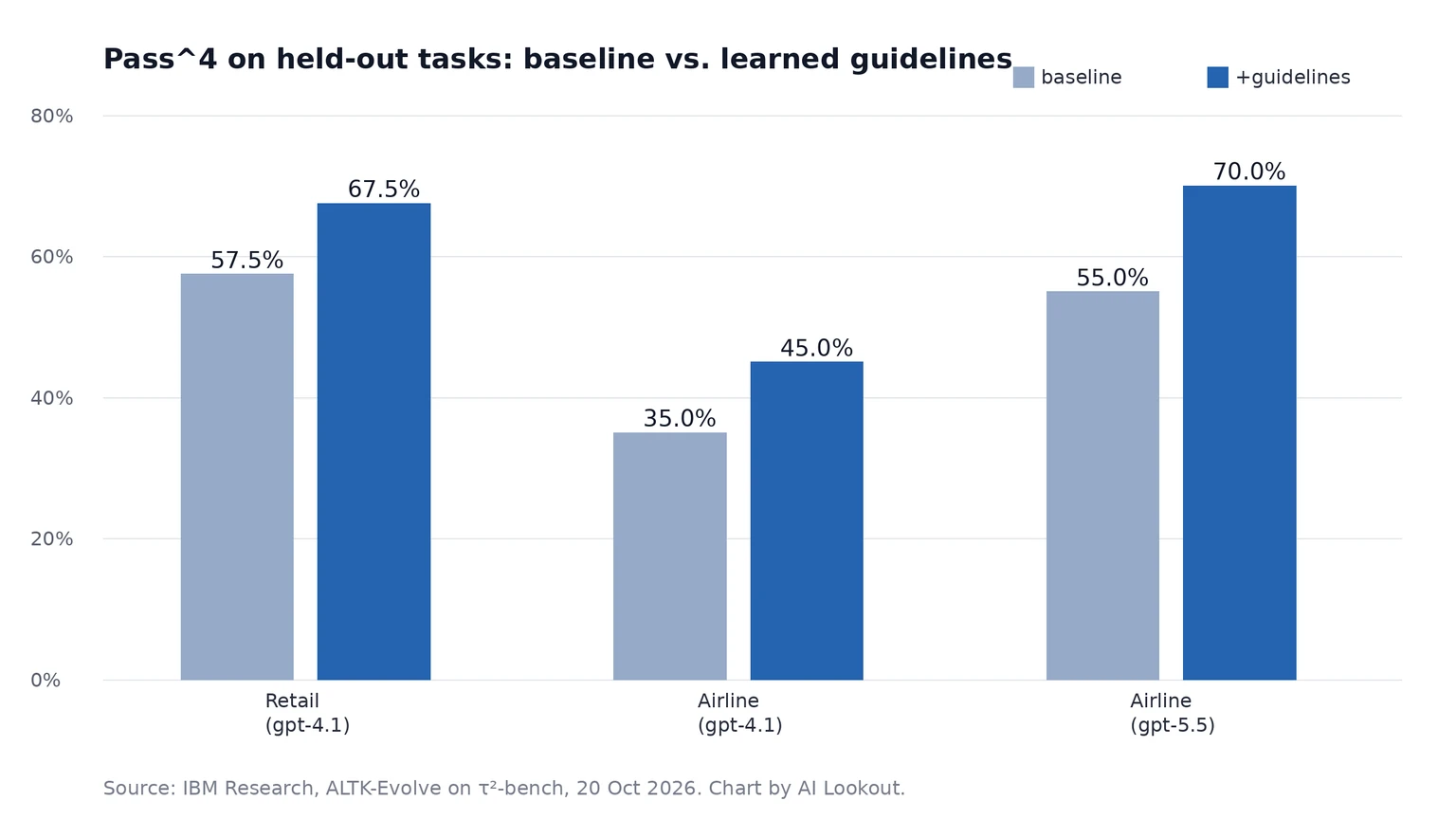
On held-out tasks with the older gpt-4.1 model, the learned guidelines lifted mean accuracy in retail from 78.1% to 82.5% and in airline from 57.5% to 65.0%. The stricter Pass^4 moved more: up 10 points in retail (57.5% to 67.5%) and 10 points in airline (35.0% to 45.0%).
IBM says the gains came from better-informed decisions, not longer conversations. On matched tasks solved both ways, the guideline runs were actually slightly shorter, trimming about 0.3 to 0.4 assistant turns. The main extra cost is input tokens for the larger prompt, which IBM says is largely recoverable with prompt caching because the guideline block is identical on every call.
On the public leaderboard snapshot from 12 October 2026, IBM reports the gpt-4.1 agent ranks first in retail at Pass^4 of 67.5%, ahead of a model that was fine-tuned on synthetic retail data. Swapping in the frontier model gpt-5.5 for the airline domain takes the same approach to 82.0% on the base split, which IBM says clears every frontier entry on that board.
Where more guidance helps, and where it does not
The two domains disagree about how much guidance pays off. In retail, more rules were better on every measure, and the full set was needed for the real jump. In airline, the full set led on accuracy, but a compact 14-rule core was the more reliable one on Pass^4, so IBM treats the amount of guidance as a dial to tune per domain rather than a fixed value.
Learned guidelines also helped a frontier model, not just a weaker one. Re-running airline with gpt-5.5 for both the agent and the rule extraction lifted accuracy from 72.5% to 82.5% and Pass^4 from 55.0% to 70.0%, a larger reliability gain than the older model saw and from a higher starting point.
Why this matters versus fine-tuning
The appeal is that it sidesteps fine-tuning. Training a model on a benchmark is expensive and brittle, and the result does not transfer to the next domain. IBM's pitch is that a stock model with a prompt-appended playbook matched or beat a fine-tuned system in retail using only rules mined from the agent's own runs, with no human labelling and no test-set leakage.
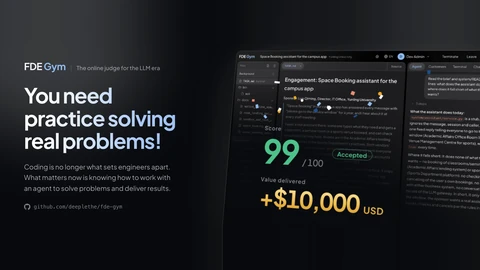
It fits a wider 2026 theme of squeezing more out of agents through scaffolding and benchmarks rather than bigger models, seen in work like the FDE-Gym benchmark for customer-delivery agents and the broader push to measure agent reliability, not just one-shot accuracy.
The limits
The caveats matter. These are IBM's own results on one benchmark with relatively small held-out sets (40 retail and 20 airline tasks), and tau2-bench is a simulated environment, not live customer traffic. The leaderboard comparison is a snapshot that will shift as others submit.
The method also depends on having good training tasks to learn from, and the best amount of guidance varies by domain, so it is not a single setting that works everywhere. Reliability on four tries is a stricter bar than accuracy, but it is still not the same as never failing a real customer.
How to try it
ALTK-Evolve is available on GitHub under the Apache-2.0 licence, with a lighter version the team says slots into existing coding assistants and an MCP-server variant for tool integration. The tau2-bench harness it builds on is Sierra's open MIT-licensed benchmark.
Teams building policy-bound agents can test the core claim directly: run their own agent on practice tasks, mine guidelines from the transcripts, append them to the prompt, and measure Pass^4, not just average accuracy, on held-out cases. The honest read is that this is a cheap, transferable way to make agents more reliable on a benchmark, with real-world value still to be proven.
Common questions
What is ALTK-Evolve?
An open-source method from IBM Research that improves an AI agent by mining short rules from its own practice runs and adding them to the prompt, instead of fine-tuning the model.
What did it achieve on tau2-bench?
IBM says it reached first place on the retail leaderboard snapshot with an older model and first on airline with a frontier model, lifting the strict Pass^4 reliability score by 10 to 15 points on held-out tasks.
Does it need fine-tuning?
No. The model's weights are unchanged. The learned guidelines are simply appended to the system prompt, which IBM says is cheaper and transfers better than fine-tuning on a benchmark.
Sources & further reading
How this story was made
Written by Kristian Kostov with AI assistance and checked against the linked sources. Company performance claims are attributed to the company. Analysis reflects AiLookout’s interpretation; we have not independently tested the products discussed. The cover places the companies’ own logos, taken from public-domain or openly licensed files credited in the caption, on a plain background. It is not a product photograph, a screenshot, or an endorsement.
Our editorial standards