Announced 12 Oct 2026 · Sources checked
What did Google announce?
Google bundled four announcements into one day. In a short overview post, it introduced a new tracker, Google Fitbit Edge; new background health features for its screenless Fitbit Air band; a multi-year partnership with the period-tracking company Flo Health; and new hires who join basketball player Stephen Curry, its “Performance Advisor”, on the Google Health team.
The company frames the release as part of a shift it started a few months ago, when it introduced the Google Health app, Fitbit Air and Google Health Coach, an AI coach built on Gemini models that reads a user’s sleep, activity and heart data and answers questions in conversation.
Google says it has shipped more than 55 features and fixes to the app since then, including better coach memory, deeper Apple Health integration and meal logging from a photo. The 12 October release is the first to add new kinds of health estimates rather than just new screens.
What is Fitbit Edge?
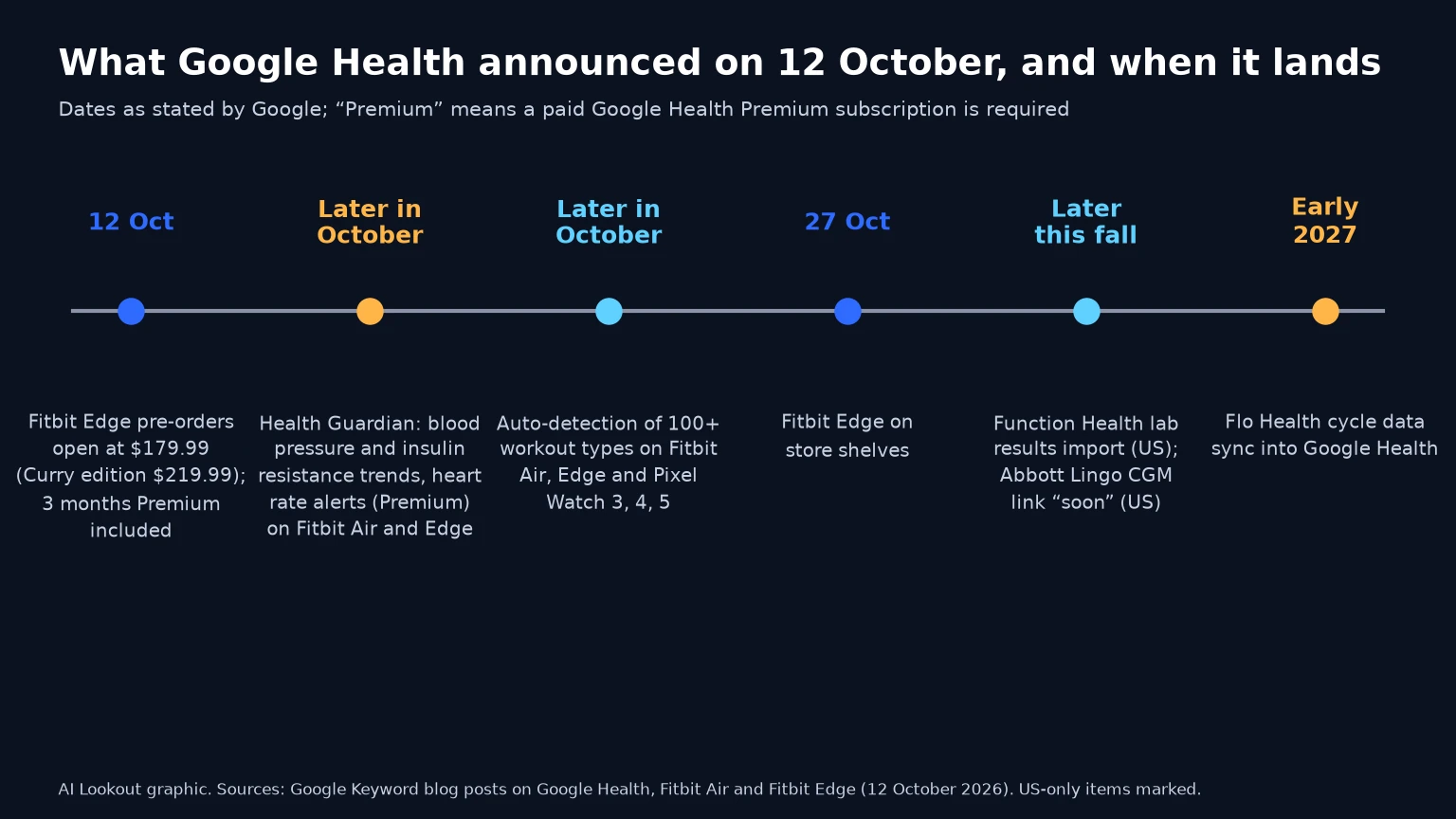
Fitbit Edge is a slim tracker with a screen, positioned between the screenless Fitbit Air and the Pixel Watch 5 smartwatch. According to Google’s launch post, it is 11.5 mm thin, has a Hybrid OLED display with 46% more viewing area than earlier Fitbit trackers, and a case Google says is 45% lighter than the Apple Watch Series 12.
It has built-in GPS that Google says is up to 40% more accurate than previous generations, an altimeter, continuous optical heart-rate sensing, an ECG app in select countries and a skin-temperature sensor used for overnight recovery scores. Google quotes up to seven days of battery and says five minutes on a 30W charger gives a day of use. It is also Google’s first repairable tracker, with a modular interior and a replaceable battery.
Software is where the AI comes in. The Edge shows glanceable tiles for sleep, cycle tracking and heart rate, tracks more than 50 exercise modes with real-time guidance, and acts as what Google calls an “on-wrist window” to the Health Coach. The coach itself still runs in the cloud: Google’s footnotes say it needs a Google Health Premium subscription, the app and an internet connection.
How do the Health Guardian trend features work?
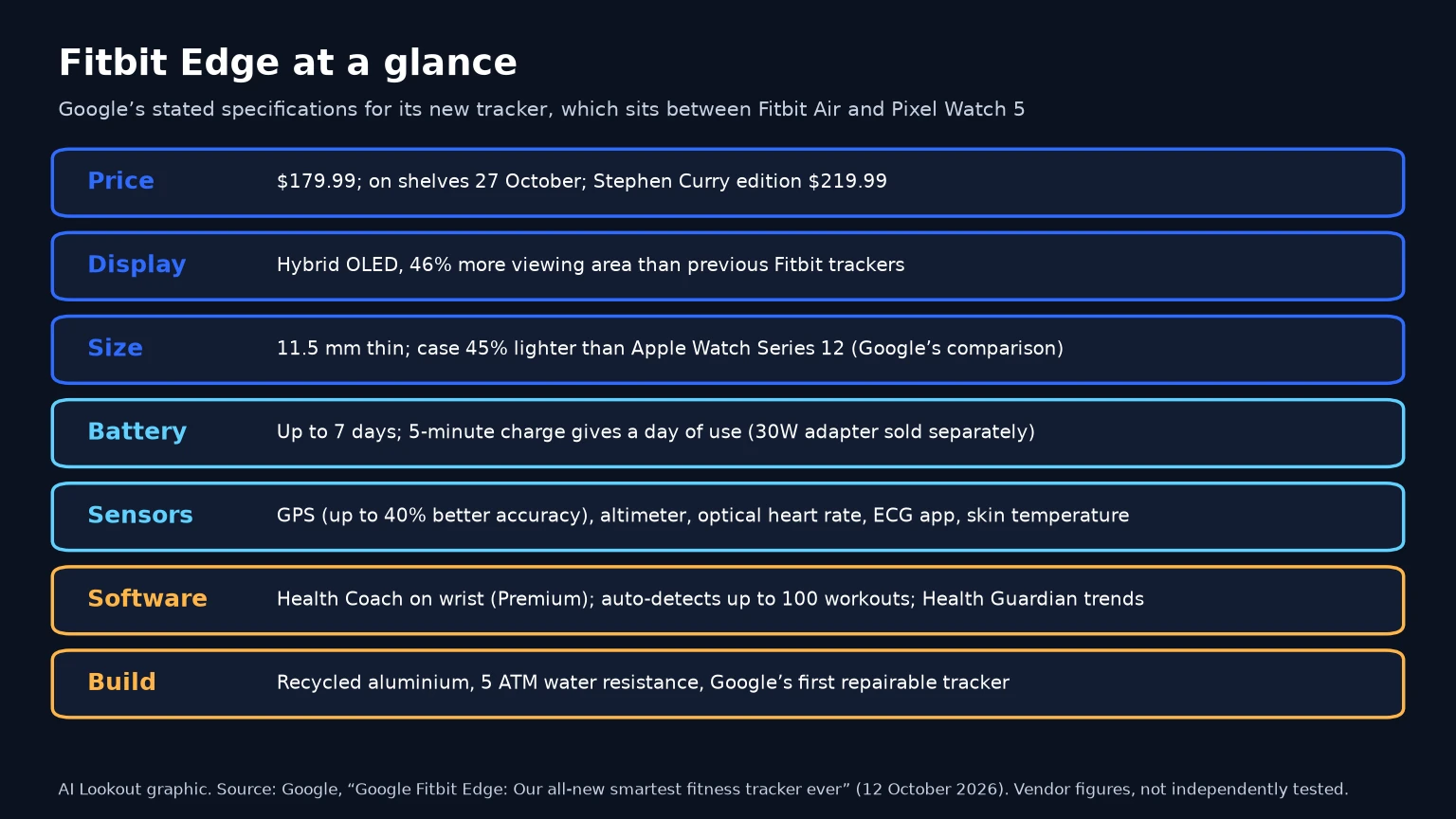
Health Guardian is a new set of background features in the Fitbit Air update. It includes blood pressure trends, insulin resistance trends and alerts when heart rate stays unusually high or low. It reaches Fitbit Air and Fitbit Edge later in October, for Premium subscribers only.
The trend features are not readings. Users set them up in the Google Health app, and if they wear the tracker enough each month to meet Google’s wear requirements, they receive a report at the start of the next month. The Health Coach can then explain shifts in the pattern, adjust a fitness plan and suggest what to raise with a doctor.
Google’s footnotes are unusually explicit. The features are “intended for general wellness and informational purposes only”, are not a prescreener for diabetes or hypertension, do not give real-time clinical readings, should not be used to adjust medication, and should not be used during pregnancy. The posts do not say what signals or models produce the estimates, how accurate they are against cuff readings or blood tests, or which countries will get them.
That gap matters. A tracker has no cuff and draws no blood, so any blood pressure or insulin resistance figure is a model’s inference from indirect signals such as heart rate, heart rate variability, activity and sleep. Without published validation, users and doctors cannot judge how much weight a monthly trend deserves.
What changed in automatic workout detection?
The most concrete AI change is in automatic workout detection, which arrives later this month on Fitbit Air, Fitbit Edge and the Pixel Watch 3, 4 and 5. Google says the number of activities a device can recognise rises from 10 to more than 100, including strength training, swimming, racket sports and team sports.
The detector now uses what Google calls contextual reasoning: it weighs a user’s routine, history, past manual edits and, with permission, location. Google says this delivers nearly twice as many accurate detections and cuts missed workouts by more than half, based on offline tests comparing the new model with the old one on manually tracked workouts. Sessions of at least 15 minutes with a sustained raised heart rate are logged automatically, usually within 30 minutes, and each confirmation or correction is used to learn the user’s patterns.
Which apps and devices now feed Google Health?
Google is also widening what the coach can see. The partners and timings it gives are as follows.
- Flo Health: from early next year, users can sync cycle data from Flo into Google Health for insights tied to cycle phase and life stage, and the two companies plan joint research on women’s health.
- Abbott: US users will “soon” be able to connect Abbott’s Lingo over-the-counter continuous glucose monitor, so glucose readings sit next to meals, workouts and sleep.
- MyFitnessPal: Premium MyFitnessPal users can share food-level logs; free users can still share daily meal logs.
- Function Health: US users can import clinical lab results from later this fall.
Why does this matter for AI health coaching?
Health is one of the areas where AI companies most want daily, personal use, and also where mistakes carry the most weight. Google’s research arm has published more cautious work, such as its AMIE primary-care feasibility study in The Lancet, in which 98 patients used a conversational diagnostic model before urgent-care visits. The Fitbit release is the consumer end of the same ambition, with far less published evidence behind each feature.
Regulators are moving too. The UK, for example, has accepted all 44 recommendations of its healthcare AI commission and expanded its sandbox for AI medical devices. By labelling Health Guardian as general wellness rather than making medical claims, Google stays on the consumer side of that line while still putting blood pressure and insulin resistance language in front of ordinary users.
What are the limits?
Every number in this story is Google’s own, and the hardware was not available to test. The battery figure comes from pre-production testing in California, the accuracy claims for detection come from Google’s offline evaluation, and the size comparison with Apple’s watch is Google’s.
The bigger unknown is Health Guardian. Google has not published validation data, error ranges or the populations it was tested on, and availability “varies by region/country and device”. Until it does, the trend reports are best read as prompts to get a proper measurement, which is what Google’s own disclaimers say.
Common questions
Does Fitbit Edge measure blood pressure?
No. It has no cuff. Health Guardian estimates blood pressure trends from tracker data and sends a monthly report to Premium subscribers who meet wear requirements. Google says it is not a prescreener for hypertension and does not give clinical readings.
When can I buy Fitbit Edge, and what does it cost?
It is on pre-order now for $179.99 and reaches stores on 27 October. The Stephen Curry Special Edition costs $219.99. Purchases include three months of Google Health Premium.
Which devices get the new workout detection?
Google says it rolls out later this month to Fitbit Air, Fitbit Edge and Pixel Watch 3, 4 and 5, recognising more than 100 activity types.
What to remember
Google’s Fitbit Edge is a fairly conventional tracker; the news is the software around it. Health Guardian moves Google’s AI coaching into blood pressure and insulin resistance estimates, behind a subscription and wrapped in wellness disclaimers. How useful those trends are will depend on validation data Google has not yet published.
Sources & further reading
How this story was made
Written by Kristian Kostov with AI assistance and checked against the linked sources. Company performance claims are attributed to the company. Analysis reflects AiLookout’s interpretation; we have not independently tested the products discussed. Cover photography is illustrative and does not depict the specific announcement or product.
Our editorial standards