Announced 15 Oct 2026 · Sources checked
What Goodfire published on 15 October
Goodfire, the interpretability company behind the Silico platform, listed “Neural Networks Are Already Clean” on its research page on 15 October 2026. The essay itself is signed by Nick Cammarata, describes itself as “an informal research essay and working hypothesis,” and estimates a 65-minute read. Its subtitle states the claim: the cause of polysemanticity in early model organisms was not superposition but “several ordinary, mostly fixable issues,” and “we can now understand most neurons in models up to trillions of parameters.”
The author matters here. Cammarata co-wrote the 2020 Distill article Zoom In, which introduced the circuit that became an early showcase for superposition, and he worked on OpenAI's 2023 attempt to have language models explain neurons automatically. In the essay he says he was a “staunch superposition believer” and helped propose both of the competing explanations he now weighs against each other.
The essay is interactive. It links neuron “microscopes” for InceptionV1 and a family of ConvNeXt vision models, attribution graphs for language-model prompts, and ablation experiments readers can inspect. It also says a technical companion paper will give a more detailed account of the language-model neuron work. That paper had not been published when AI Lookout read the essay on 16 October.
Why superposition mattered so much
Mechanistic interpretability tries to explain what a model computes by studying its internal parts. The cleanest unit would be the neuron, if each neuron did one understandable job. Early work found many that did not: so-called polysemantic neurons that seemed to respond to unrelated things.
Superposition offered an explanation. When a network runs short of neurons, the theory goes, it starts packing unrelated features into the same units because they rarely collide. If that is true, a neuron's mix of jobs tells you little, and you must first “unfold” the network before you can study it. In practice that means training a second model, such as a sparse autoencoder, to approximate the network as a larger set of cleaner features, then studying that approximation instead of the original.
That assumption has shaped years of research and tooling across labs and startups. It also shapes safety arguments: if models are knotted by design, auditing them for dangerous behaviour is much harder. Debates over how far outsiders can inspect frontier models, such as Anthropic giving METR evaluators employee-like access, sit on top of the question of what can actually be understood once you are inside.
The cat-and-car neuron, reread
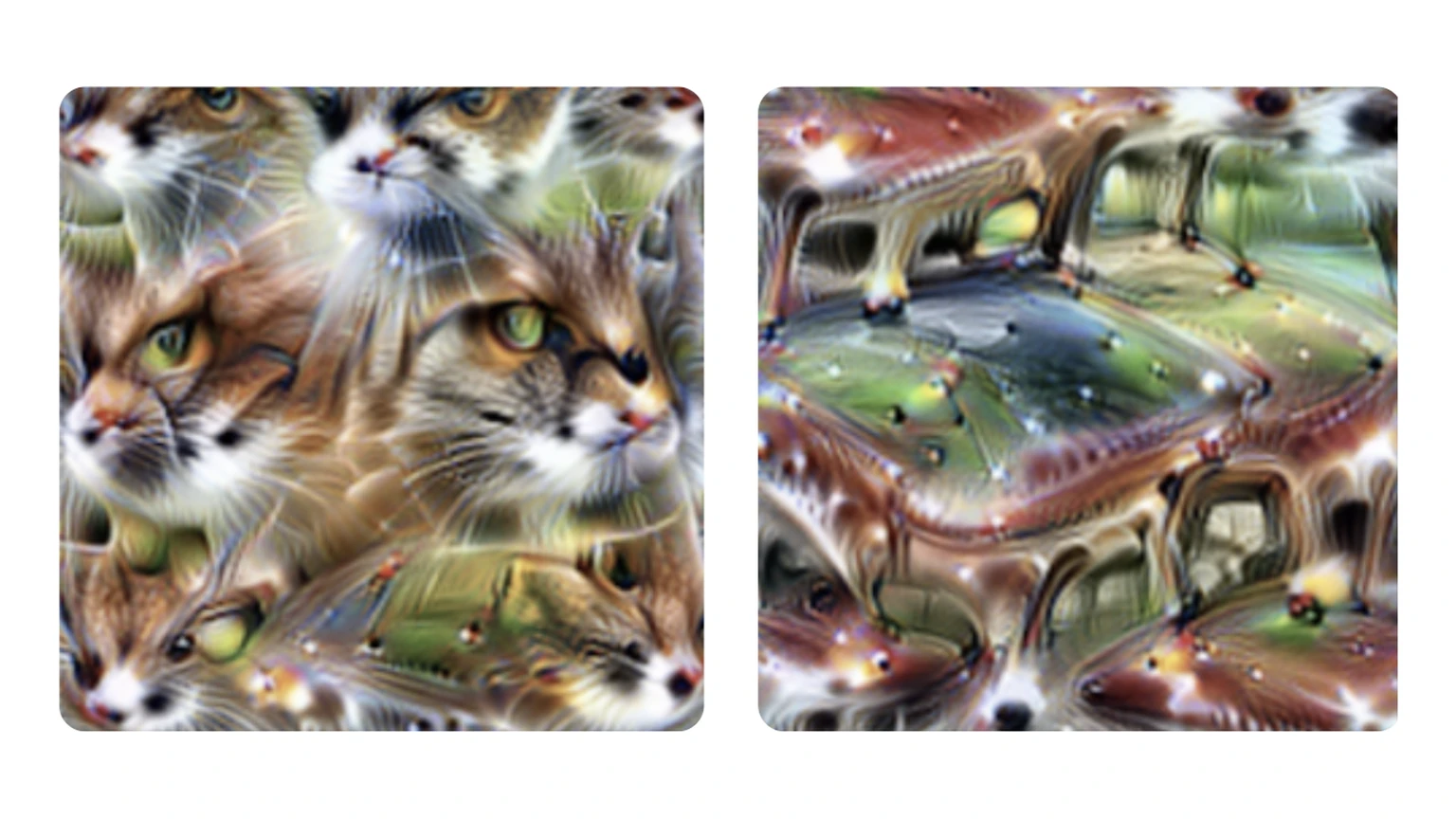
The most famous polysemantic neuron is 4e:55 in Google's InceptionV1 image model. Its feature visualizations show cat faces and car fronts, and the Zoom In article stated that it “isn't responding to some commonality of cars and cat faces.” Cammarata now says it is. Looking again, he concluded it is a V-shape neuron: pointed things such as fox snouts, flames and a fireboat's water jets drive it, and round things such as an O push it negative. The cat whiskers in the visualizations, he argues, came along because the optimisation found a cat route into a V detector, not because the neuron wants whiskers.
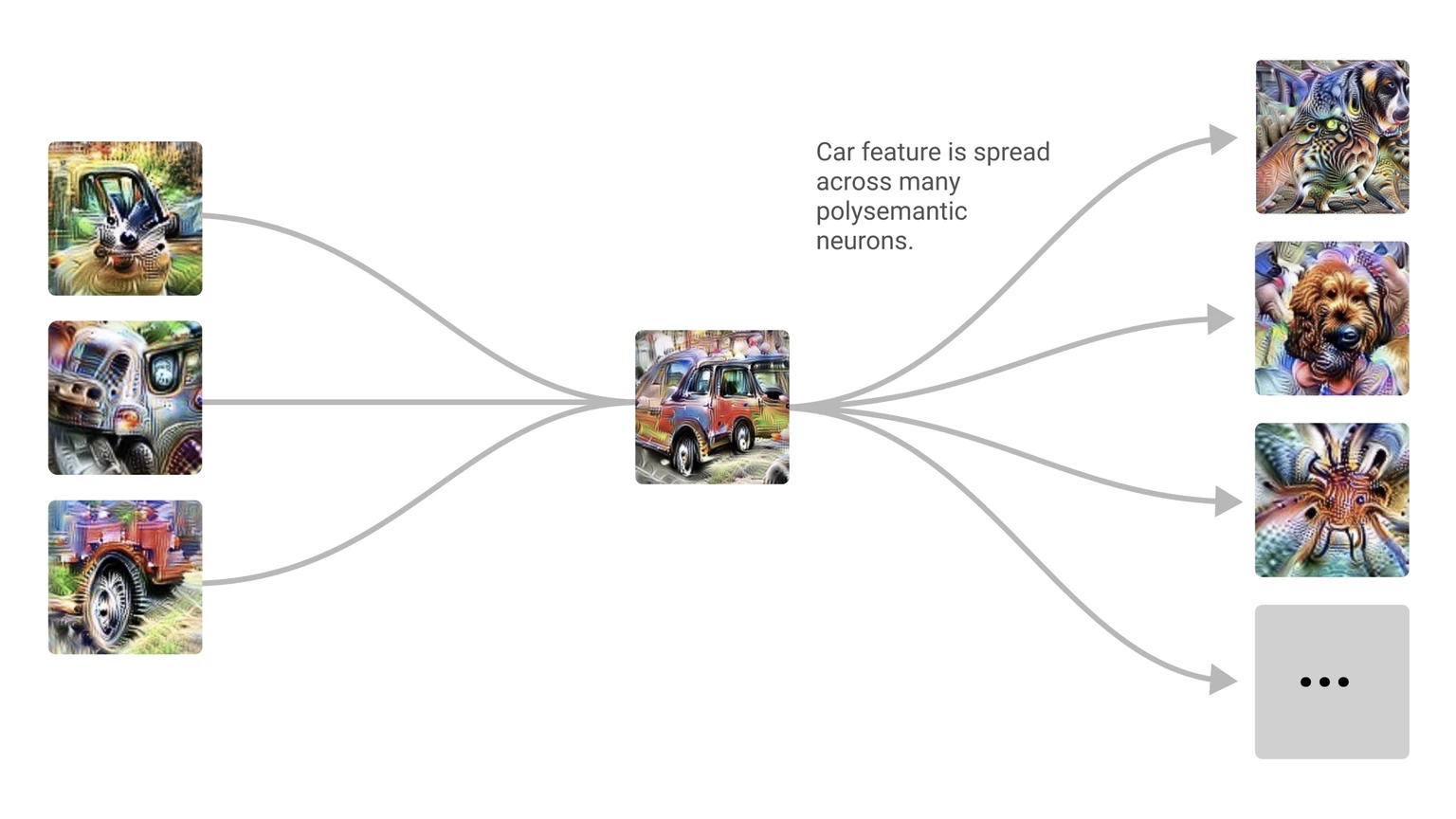
He applies the same reading to the 2019 circuit in which a car feature appeared to spread into a set of dog neurons, the example originally used to introduce superposition. In his account nothing downstream reads that combination, so it was not hiding a feature in a high-dimensional space; it was ordinary generalization and composition.
The larger vision claim is about architecture. Cammarata says InceptionV1's late layers “overflowed” because of design problems, and weak tools made them look incoherent. With later architectural improvements and no change to model size or data, he reports that 99 to 100% of neurons in the retrained model's last layer are easily interpretable, across versions trained over a 300-fold range of sizes. Smaller networks, he says, do not fold unrelated things together; their neurons just cover coarser concepts, like one car neuron for many kinds of car.
What Goodfire says it found in language models
For language models, the essay compares its numbers with two landmark efforts. Anthropic's 2023 Towards Monosemanticity gave the median neuron in a small one-layer model a 0 out of 14 on its interpretability rubric. OpenAI's 2023 automated interpretability project found about 1.7% of neurons interpretable by its most generous measure.
Against that, Cammarata reports that in preliminary audits of Qwen3-32B roughly 90% of neuron poles have one main job, about 7% have two related jobs, and only about 2 to 4% are not yet understood. He adds that dense and mixture-of-experts models look similar and that Goodfire found similar results in models up to trillions of parameters, including Kimi K3. He is careful to say the share depends on thresholds, such as how far into weak activations you look and what counts as “one thing,” and that a single cleanliness score should be treated as a rough pointer.
Most remaining mixed neurons, he argues, show “recursive generalization”: a neuron that detects one pattern sprouts related offshoots as it grows. One neuron that detected the letters “iy” went on to fire for “diy” and then “do it yourself.” He also stresses negative poles. In a Qwen example about Santa, removing eight neurons whose strongly negative side encodes Santa lore drops the model's Santa answer from near-certain to about 6%, while removing twenty neurons labelled Christmas or Santa only drops it to 76%. The essay also shows what Goodfire calls the first published neuron-only attribution graph of a multi-trillion-parameter model, Kimi K3 deciding to return a found wallet.
How agents change the economics of interpretability
A thread through the essay is that interpretability failed partly for lack of labour. Cammarata says the 2023 explainer models could not run a loop of conjecture and test, metrics rewarded explanations that simulated activations rather than correct ones, and studies used small models that really had run out of room.
Today, he writes, agents can map neurons and circuits, build explorable microscopes, test explanations, and track hundreds of thousands of attribution graphs. He compares the process to a crossword: once part of the grid is filled, each new neuron is constrained by its neighbours, so progress accelerates. Using that approach, he says, colleagues found a previously unnoticed double-negative regime in SwiGLU neurons. Goodfire has argued for this kind of practical, neuron-level work before, for example when it trained production cyber monitors on Kimi K3.
Cammarata's own summary has four steps: networks mostly use one learning principle, not two; science on them goes better than expected with modern tools; understanding compounds; and, flagged as “highly speculative,” this might be most of what interpretability needs. He frames it as a possible bitter lesson for the field: scaling ordinary investigation may beat engineering cleverer decompositions.
Who is pushing back
Reaction on X, collected on Techmeme on 16 October, split quickly. Some researchers and investors called it a landmark. Others were measured. Interpretability researcher Neel Nanda wrote that it is “interesting work, but I don't think it's a significant update to the big picture of interpretability,” while welcoming neuron-based attribution as a practical tool. Liv Gorton wrote that she thinks “the argument here mischaracterises what superposition predicts.” Jan Kulveit called it “an over-update” and noted that classical misalignment risk is only one part of overall AI risk.
Those objections go to the core. Superposition theory does not claim every neuron is a random mix; it predicts some features will be shared across units under pressure. Showing that many neurons look clean, or that famous examples were misread, does not by itself prove that no important features are distributed. The essay's language-model numbers also rest on Goodfire's own audits, labels and thresholds, with the detailed methods still to be published.
What would settle it
The companion paper is the next checkpoint. Useful evidence would include released neuron labels and audit protocols for Qwen3-32B and Kimi K3, blind replication by groups that did not write the labels, and head-to-head tests where neuron-level explanations predict or control behaviour better than sparse-autoencoder features on the same tasks. The vision microscopes are already public, which makes the InceptionV1 and ConvNeXt claims the easiest to check first.
For readers outside the field, the safe takeaway is narrower than the excitement online. A respected researcher who helped build the superposition story has published a detailed argument that it was largely wrong for the canonical cases, plus early evidence that large language models are more legible than assumed. If others reproduce it, auditing models from the inside gets cheaper. If they do not, it will still have sharpened what the field needs to measure.
Common questions
What is superposition in neural networks?
It is the hypothesis that when a network lacks enough neurons, it packs unrelated features into the same units. It motivated tools like sparse autoencoders that try to unfold a model before studying it.
Is this a peer-reviewed paper?
No. Goodfire calls it an informal research essay and working hypothesis. A technical companion paper on the language-model experiments is promised but had not appeared by 16 October 2026.
Does this mean AI models are now understood?
No. Cammarata says trillion-parameter models are not close to solved because of their size; his claim is that studying them directly now looks tractable, and critics dispute how much it changes.
Sources & further reading
How this story was made
Written by Kristian Kostov with AI assistance and checked against the linked sources. Company performance claims are attributed to the company. Analysis reflects AiLookout’s interpretation; we have not independently tested the products discussed. The cover is a cropped example output published by the developer in its openly licensed repository, credited in the caption. It is not an AiLookout test or screenshot.
Our editorial standards