Announced 12 Oct 2026 · Sources checked
What did DigitalOcean announce on 12 October?
DigitalOcean’s investor release on 12 October 2026, timed ahead of the Open Intelligence Summit, says the company is launching Agent Learning and Data Services so teams can run self-improving agents on one platform. Together with Inference Engine and Managed Agents, DigitalOcean claims it is among the few clouds where agents can run, learn and improve without stitching four or five tools together.
Chief product and technology officer Vinay Kumar’s quoted line is blunt: the question has moved from whether a team can launch an agent to whether that agent gets better with every run. The release pairs that claim with partner colour from Amplitude, which says its Wave agentic product team runs on DigitalOcean Managed Agents and picks models per task based on results, not only cost. Those are company statements, not independent case studies.
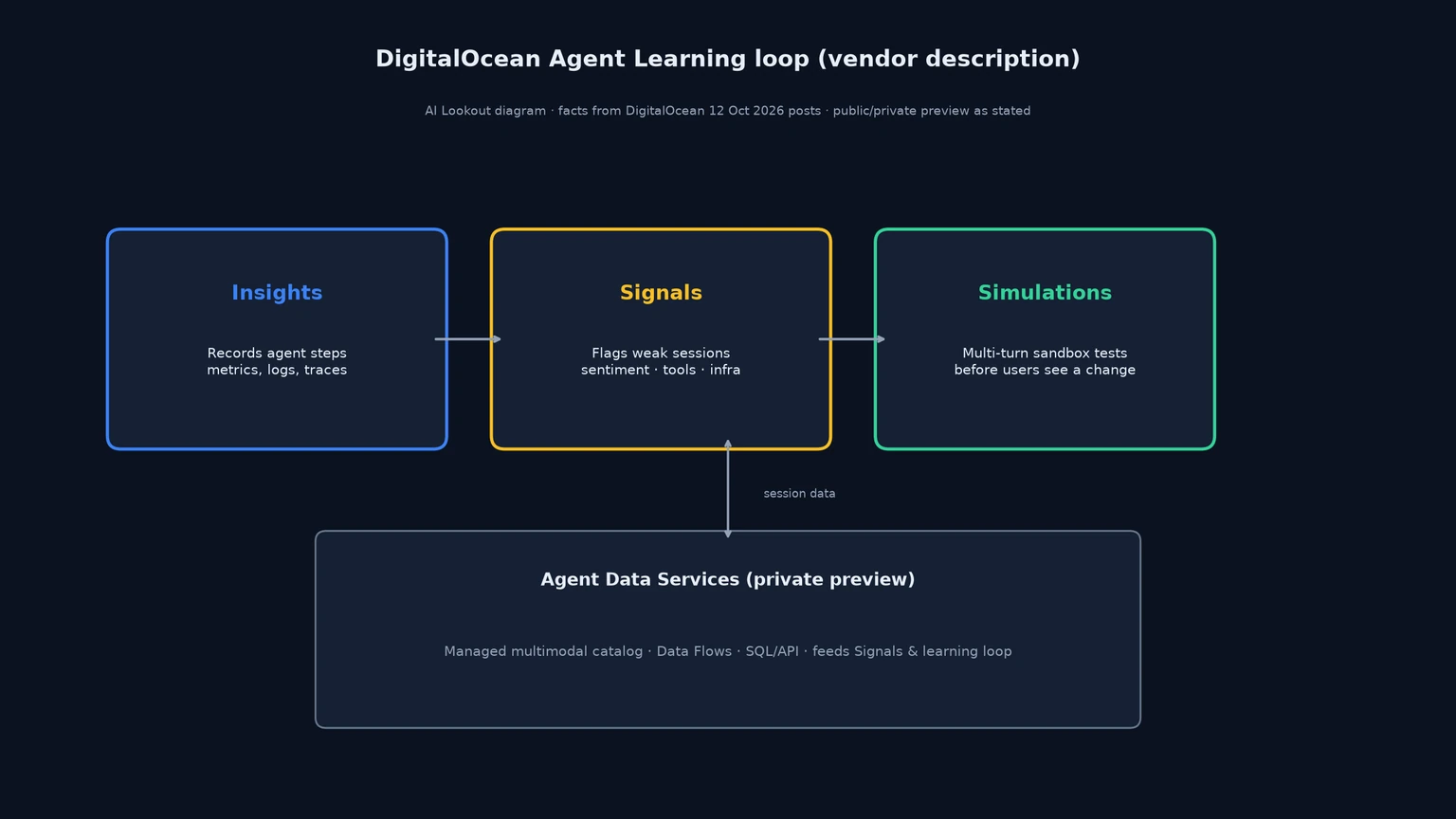
Three product blogs published the same day unpack the pieces: Agent Data Services, Signals and Simulations, and Insights. Read together, they describe one feedback loop rather than three unrelated launches.
How does the Agent Learning loop work?
DigitalOcean’s diagnosis of the status quo is familiar to anyone who has shipped an agent. Production logs show that the system was up and latency was fine; they do not show that the agent called the wrong tool, used stale context, or drove a frustrated user to quit. A fix is often a prompt tweak with no realistic replay, so the first person to notice a regression is a customer. Improving the model usually means exporting production data to a training vendor and wiring several tools, so it happens quarterly or not at all.
Agent Learning Services are DigitalOcean’s answer to that loop. Insights is the observability layer: metrics, logs and traces from Serverless Inference, Batch Inference, Inference Router, Managed Agents, Action Gateway, DigitalOcean Kubernetes and App Platform, on OpenTelemetry, with dashboards, explorers, PromQL, alerts and an API. It is the same layer that already powers Managed Agents’ end-to-end run views, now extended across more of the stack.
Signals watches production traffic on Managed Agents and Inference Engine and highlights sessions that look informative: frustrated users, failing tools, infrastructure constraints. DigitalOcean says it uses an inexpensive first-pass triage rather than grading every transcript with an LLM judge, citing its paper “Signals: Trajectory Sampling and Triage for Agentic Interactions” with an 82% informativeness rate and 1.52× efficiency gain over random sampling on τ-bench in a controlled study. Those figures are the company’s; they have not been independently replicated here.
Flagged sessions can become evaluation scenarios in one click. Simulations, a new capability inside Evaluations, then plays multi-turn scenarios against a candidate change in an isolated Harness Runtime sandbox, with the same Action Gateway tools the agent uses in production. A user simulator takes different paths across episodes; an LLM judge scores trajectories on goal completion, knowledge retention, tool-use accuracy and custom metrics. DigitalOcean says Simulations works with harnesses such as Claude Code, Codex and OpenCode in this preview, and that third-party frameworks such as LangChain, Hermes and CrewAI are not supported yet.
What is Agent Data Services?
Agent Data Services is the data foundation the loop sits on. DigitalOcean describes managed Data Flows that process, enrich and index arrivals; a single governed catalog that holds structured records and vectors with lineage; and query over SQL or an API so people and agents share the same fresh context. Multimodal content—video, audio, documents, logs and agent sessions—lands with configurable redaction. Workspaces are described as logically isolated, with team roles, API tokens and audit logging.
The same store is meant to capture execution traces so Learning Services can turn behaviour into structured data. Signals writes sessions into it; the Inference Router optimizer draws training and test data only where the customer expressly opts in. Teams can also use it for search and analytics across video, audio, documents and structured records, and for grounding any agent in company data without running their own pipeline fleet.
That pitch overlaps other managed RAG and observability products. DigitalOcean’s differentiator claim is consolidation on the same cloud as its Inference Engine and Managed Agents, so context, compute and learning stay in one account boundary. Whether that beats a best-of-breed stack is an engineering trade-off the preview is meant to answer.
What is available now, and what is still private preview?
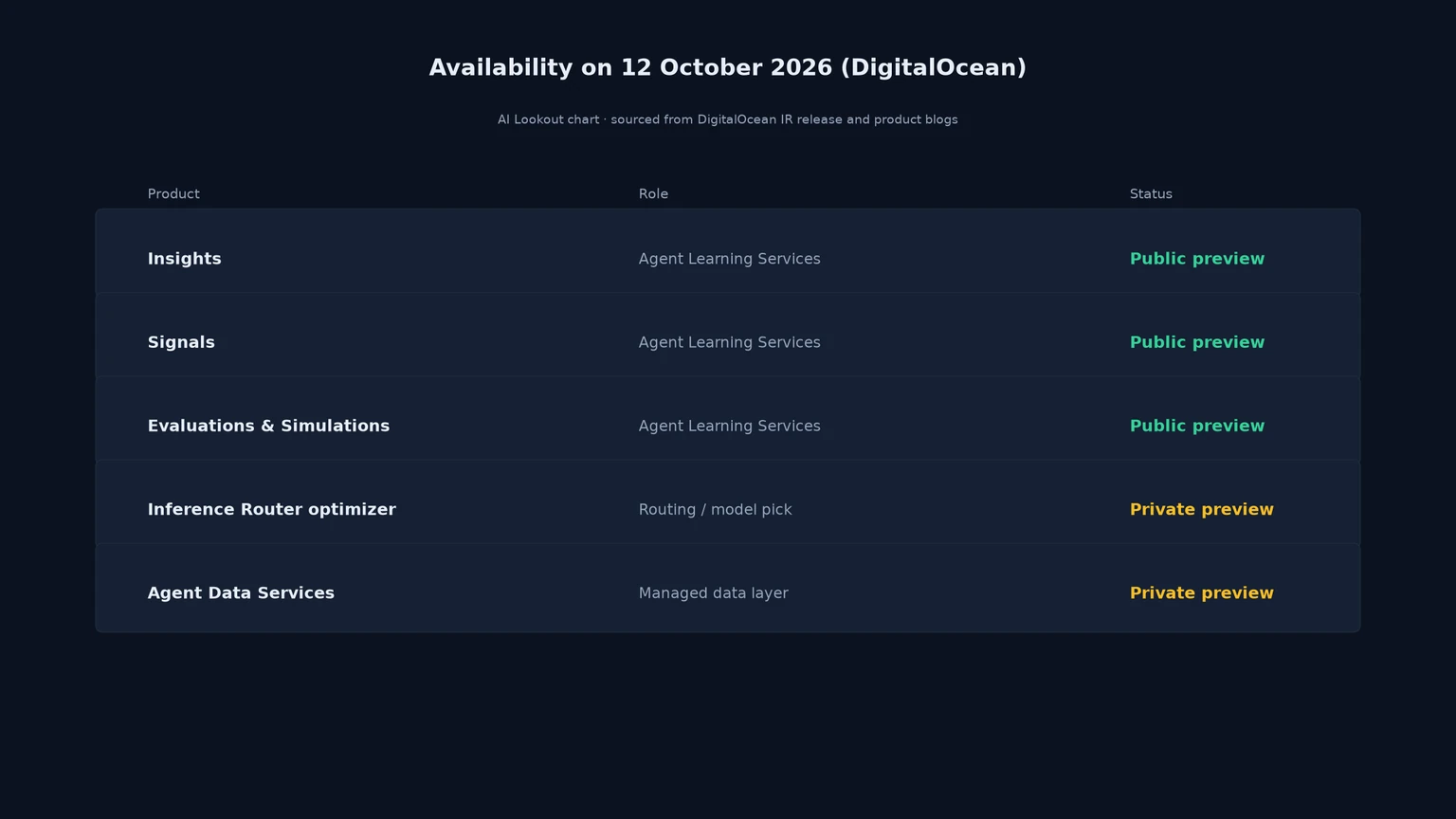
Availability is the part teams need before they rearrange a roadmap. According to the IR release, Agent Learning Services—Insights, Signals, and Evaluations and Simulations—are available today in public preview. The Inference Router optimizer and Agent Data Services are private preview, with access requests pointed at DigitalOcean’s try page. Insights is described as free during public preview, subject to preview terms and usage or retention limits in the documentation; DigitalOcean says it expects to begin charging at GA and will announce pricing before billing starts.
Preview caveats are explicit in the forward-looking statements. Preview services are provided “as is,” are not supported for production workloads, and may change, never become generally available, or be discontinued. Agent Data Services’ blog repeats that private-preview features lack DigitalOcean’s standard compliance certifications and SLA. Anyone treating these as production commitments is reading past the company’s own warnings.
For teams already on Managed Agents, the onboarding path DigitalOcean describes is concrete: enable Signals in Data & Learning or from Harness Runtime, wait up to an hour for processing, review trends, export flagged sessions into Evaluations, and run Simulations before shipping a change. Simulations is said to inherit Agent Droplets plan discounts—15% on Pro and 20% on Team—for scenario generation, user simulation and LLM judging. Those commercial details matter for cost modelling, but they are still preview economics.
How does this fit DigitalOcean’s agent stack?
DigitalOcean has been assembling an agent stack in public for months: Inference Engine for serving, Managed Agents and Harness Runtime for acting, and now Learning plus Data for improving. That sequence matches a broader industry move from “can we call a tool” to “can we measure and harden the agent in production,” a theme we covered when Microsoft shipped Agent Lightning and when NVIDIA opened OpenShell for agent safety.
The Signals paper’s sampling approach also sits next to other production-agent monitors. DigitalOcean’s claim is that triage must be cheap enough to run at high trace volume—raw volume “can exceed 100 GB/s” in the Signals post—while still finding sessions worth a human or LLM look. That is a different problem from sandboxing agents at the OS layer, which is what products such as AWS Strands Box emphasise. Observability and containment are complementary, not substitutes.
Amplitude’s quote is useful as a named early user story, but it is still a partnership quote in a launch release. Independent latency, cost and quality numbers for Signals triage or Simulation judging are not in the materials we reviewed.
What does the Open Intelligence Summit add?
The Open Intelligence Summit runs 12–13 October 2026 at The Midway in San Francisco. Day 0 is a workshop; Day 1 is the summit, with a keynote from 1:00 pm, build/serve/run tracks, and a closing panel. Listed speakers and partners include Nous Research, OpenHands, RadixArk, Inferact (vLLM), NVIDIA, Bright Data, VAST, dbt Labs and Supabase. DigitalOcean says it will demonstrate Agent Learning and Data Services live on 13 October.
The summit branding—“open intelligence”—matches DigitalOcean’s pitch that models, agents and data should stay portable and customer-owned rather than locked to a single closed stack. That is marketing language; the product evidence is the OpenTelemetry-based Insights path, public preview of Learning services, and private preview of the data layer. Nothing in the summit page replaces the preview terms for production readiness.
What should builders treat carefully?
Treat the effectiveness numbers as vendor claims until independent teams publish their own. The 82% informativeness and 1.52× efficiency figures come from DigitalOcean’s controlled τ-bench study; production agents differ. Signals’ PII redaction and team-boundary promises are important for regulated customers, but they are design statements in a preview, not audited certifications.
Also separate announced capability from observed behaviour. Simulations that mock write tools are safer for testing, but they can miss the failure modes that only appear when a refund API or ticket system is real. Teams that already run agents on other clouds will need a migration story for traces and datasets; DigitalOcean’s pitch is strongest if you are already on its Inference Engine and Managed Agents. For a wider view of why agent populations and feedback loops matter beyond one vendor, see our earlier piece on the ecology of AI agents.
Finally, pricing at GA is still unannounced for Insights, and Agent Data Services remains invite-only. Budget and compliance reviews should wait for the GA terms rather than locking architecture to a preview.
Common questions
Is Agent Data Services generally available?
No. DigitalOcean says Agent Data Services and the Inference Router optimizer are private preview as of 12 October 2026. Insights, Signals, and Evaluations and Simulations are public preview.
Do Signals traces leave a customer’s DigitalOcean team?
DigitalOcean says Signals is opt-in, is designed to redact PII before processing, and keeps traces and trace-derived evaluations within the customer’s DigitalOcean Team boundary, never for cross-customer model training. That is the company’s statement for the preview.
Which agent frameworks do Simulations support in preview?
DigitalOcean lists harnesses supported by Harness Runtime, including Claude Code, Codex and OpenCode. It says third-party agents such as LangChain, Hermes and CrewAI are not supported in this preview.
What to remember
DigitalOcean’s 12 October launch is a coherent product story—observe, flag, simulate, and store agent context on one cloud—but it is still mostly preview. Ship production agents on it only after you accept the “as is” terms and test Signals and Simulations on your own traffic.
Sources & further reading
How this story was made
Written by Kristian Kostov with AI assistance and checked against the linked sources. Company performance claims are attributed to the company. Analysis reflects AiLookout’s interpretation; we have not independently tested the products discussed. Cover photography is illustrative and does not depict the specific announcement or product.
Our editorial standards