Announced 21 Oct 2026 · Sources checked
Blacksmith becomes a unicorn on AI-driven testing demand
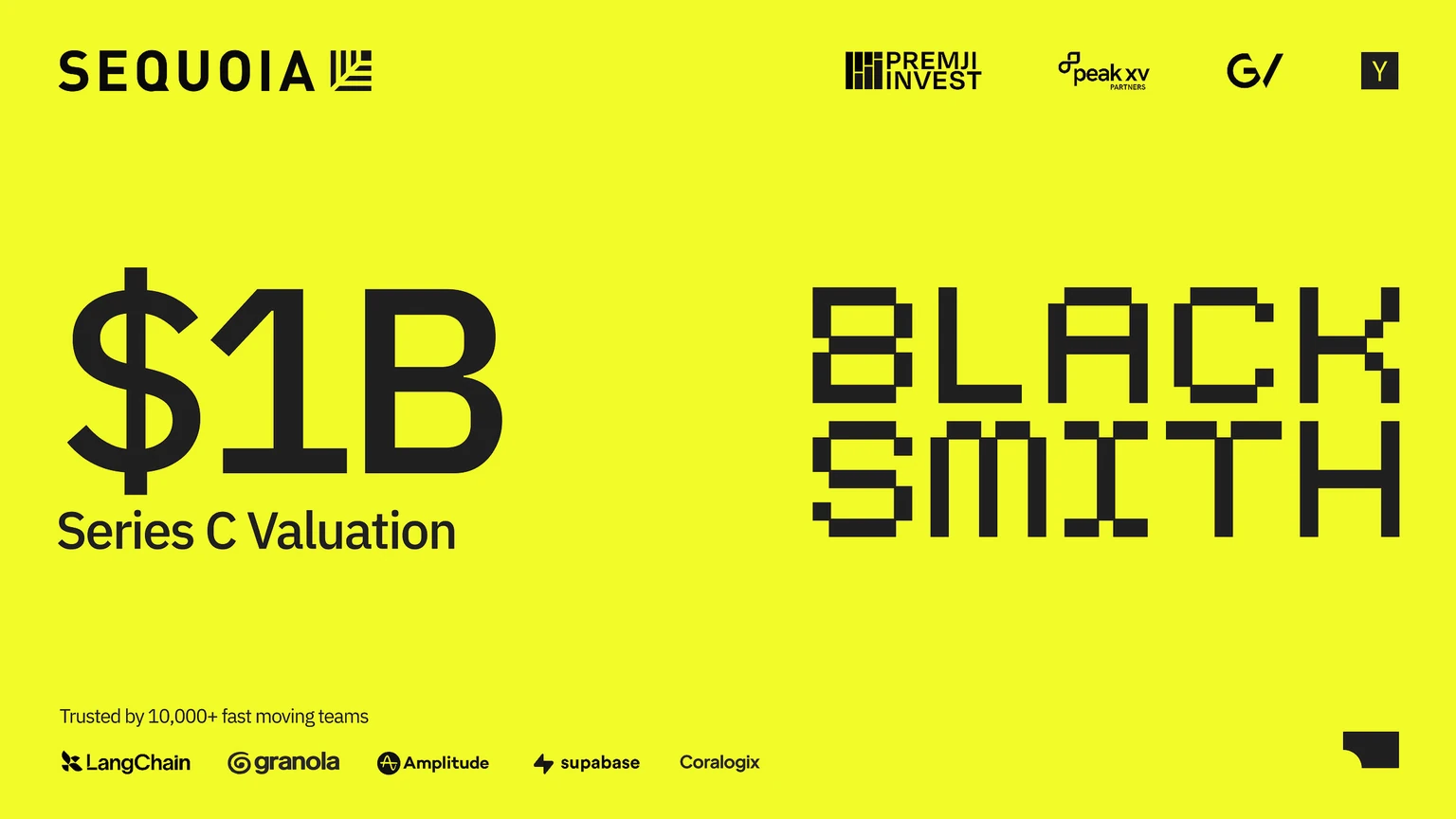
Blacksmith, a start-up that runs software builds and tests for other companies, has raised a $66 million Series C led by Sequoia Capital at a $1 billion valuation. The company announced the round on 21 October 2026, with Premji Invest joining and existing investors Peak XV Partners, GV and Y Combinator taking part again. It has now raised $125 million in total.
The pitch is simple and very much of its moment. As AI coding agents write a growing share of the world's code, the slow part of shipping software is no longer writing it but checking it. "As agents write more of the world's software, the question that matters is whether it can be trusted," co-founder and chief executive Aditya Jayaprakash wrote in a blog post, as quoted by TechCrunch. In the company's Series C post he describes Blacksmith as building a cloud for exactly that checking step.
What Blacksmith actually sells
Every change to a codebase has to be built and tested before it can be merged. That step is called continuous integration, or CI, and on GitHub it usually runs as GitHub Actions workflows on machines that either GitHub or the customer provides. Blacksmith replaces those machines. Customers change one line in their workflow file to point jobs at Blacksmith, and the company runs them on hardware it has built specifically for CI.
Blacksmith says its customers' jobs finish twice as fast and cost 60% less on average than on the alternatives, and that customers never have to provision or scale CI capacity themselves. Those are the company's own averages, not independent benchmarks. Customers named in the release include Ashby, Granola, Handshake and LangChain, and TechCrunch also lists Mercury.
The company is also moving beyond raw compute. In August it described [code]smith, a cloud coding agent that can build features and fix bugs and is wired into the validation loop to diagnose and fix failing CI runs, with a QA agent planned to test changes before they merge. That puts it closer to tools such as GitHub's agentic autofix for code scanning.
The numbers behind the round
The growth figures are steep. Since January, the number of CI jobs running on Blacksmith each week has grown from 5 million to more than 90 million, and annual recurring revenue has grown 17 times, the company says. It does not disclose absolute revenue. More than 10,000 companies now run CI on the platform, up from more than 6,000 when it announced its previous round in August.
The valuation has climbed just as fast. According to TechCrunch, Blacksmith was valued at $60 million a year ago after a $10 million Series A. Its $45 million Series B, led by Peak XV, valued it at $550 million. The company announced that round in August but said it had actually raised it in March. The Series C nearly doubles that price within months.
Blacksmith joins a group of infrastructure companies riding the agent boom to unicorn valuations this autumn. Agent sandbox provider Daytona has also raised $60 million at a $1 billion valuation on a similar argument: AI agents need large amounts of ordinary compute, not just GPUs.
Why AI coding agents create a CI problem
CI demand scales with the number of code changes, and coding agents produce far more changes than human developers. Blacksmith's August post quoted customers saying that after their developers adopted Claude Code, pull request volume rose fourfold and their CI systems started failing almost weekly. It said Claude Opus 4.5, released in December 2025, changed how developers write software, and that CI jobs on its platform had grown 5% to 10% week over week since the start of 2026.
"Since Claude Code took off in March, almost every conversation we've had with a large engineering team has started the same way," Jayaprakash said in the press release. "Developers who used to push three or four pull requests a day are now pushing orders of magnitude more and their CI infrastructure can't keep up."
The Series C post points to Anthropic, which it says wrote last month that its CI job volume grew 25 times in six months as Claude took over most of its code output. That fits what Anthropic's own teams have described: the Claude Code team doubled merged pull requests while AI review cut reverts. More code means more builds, more tests and more waiting, unless the infrastructure keeps up.
There is a deeper question here too. Research has found that coding agents can produce more code without producing more working software, because human review becomes the bottleneck. Fast, cheap testing does not solve that, but it is a precondition for any process that relies on automated checks to decide what is safe to merge.
How it runs millions of jobs a day
CI is unusually spiky. A single customer's demand can jump from zero to tens of thousands of CPUs and back again, Blacksmith says, which makes it expensive to run on general-purpose cloud machines sized for steady loads. The company manages just under 10 megawatts of compute across data centres in the United States and Europe.
In a September engineering post, Blacksmith explained that much of its fleet uses consumer 32-vCPU gaming processors, chosen because they have the fastest single-core performance available. It described moving from a design where each host pulled jobs from a Redis queue to a central scheduler that sees the whole fleet and pushes work to machines. The old design struggled with fairness between customers and with wide jobs that need a whole machine, at times leaving fleet utilisation below 70%. At the time the company said it was running more than 10 million jobs a day.
What the money is for
Blacksmith says the money will go on hiring and on compute. It is working to grow its compute footprint at least five times in 2027, and in August it said it was hiring in New York and San Francisco. The founders, Aditya Jayaprakash, Aayush Shah and Aditya Maru, met as undergraduates at the University of Waterloo; Shah and Maru were early engineers at Cockroach Labs and Jayaprakash worked at Faire.
Sequoia partner Isaiah Boone said in the release that the founders "understood early that as AI agents wrote more code, the infrastructure to build and test it would need to change." He added that what stood out was the team's deep systems expertise and speed of execution.
What to keep in mind
Almost every number in this story comes from Blacksmith. Speed and cost claims are averages across customers with very different workloads, and the 17x revenue growth is a multiple of an undisclosed base. Moving CI to a single specialist provider also concentrates risk: if that provider has a bad day, every customer's merges wait.
Competition is real as well. GitHub sells its own larger and faster hosted runners, and several start-ups offer cheaper drop-in runners for GitHub Actions. What Blacksmith has is momentum and a clear story about AI-written code. Whether that holds will depend on whether agent output keeps growing at this pace, and whether GitHub decides to compete harder on the same ground.
Common questions
What does Blacksmith do?
It runs continuous integration jobs, the builds and tests that check code before it is merged, mainly as a drop-in replacement for GitHub Actions runners, on hardware built for CI.
Who invested in Blacksmith's Series C?
Sequoia Capital led the $66 million round, with Premji Invest and existing investors Peak XV Partners, GV and Y Combinator.
Why does AI-generated code matter for CI?
Every code change has to be built and tested. Coding agents produce many more changes, so CI volume rises; Blacksmith says its weekly jobs grew 18-fold this year.
Sources & further reading
How this story was made
Written by Kristian Kostov with AI assistance and checked against the linked sources. Company performance claims are attributed to the company. Analysis reflects AiLookout’s interpretation; we have not independently tested the products discussed. The cover is a cropped example output published by the developer in its openly licensed repository, credited in the caption. It is not an AiLookout test or screenshot.
Our editorial standards